Small IKEA designer kitchen: 8 decor ideas for a small space full of character
A small IKEA designer kitchen doesn’t have to be austere. Discover 8 decor ideas for a compact space full of life
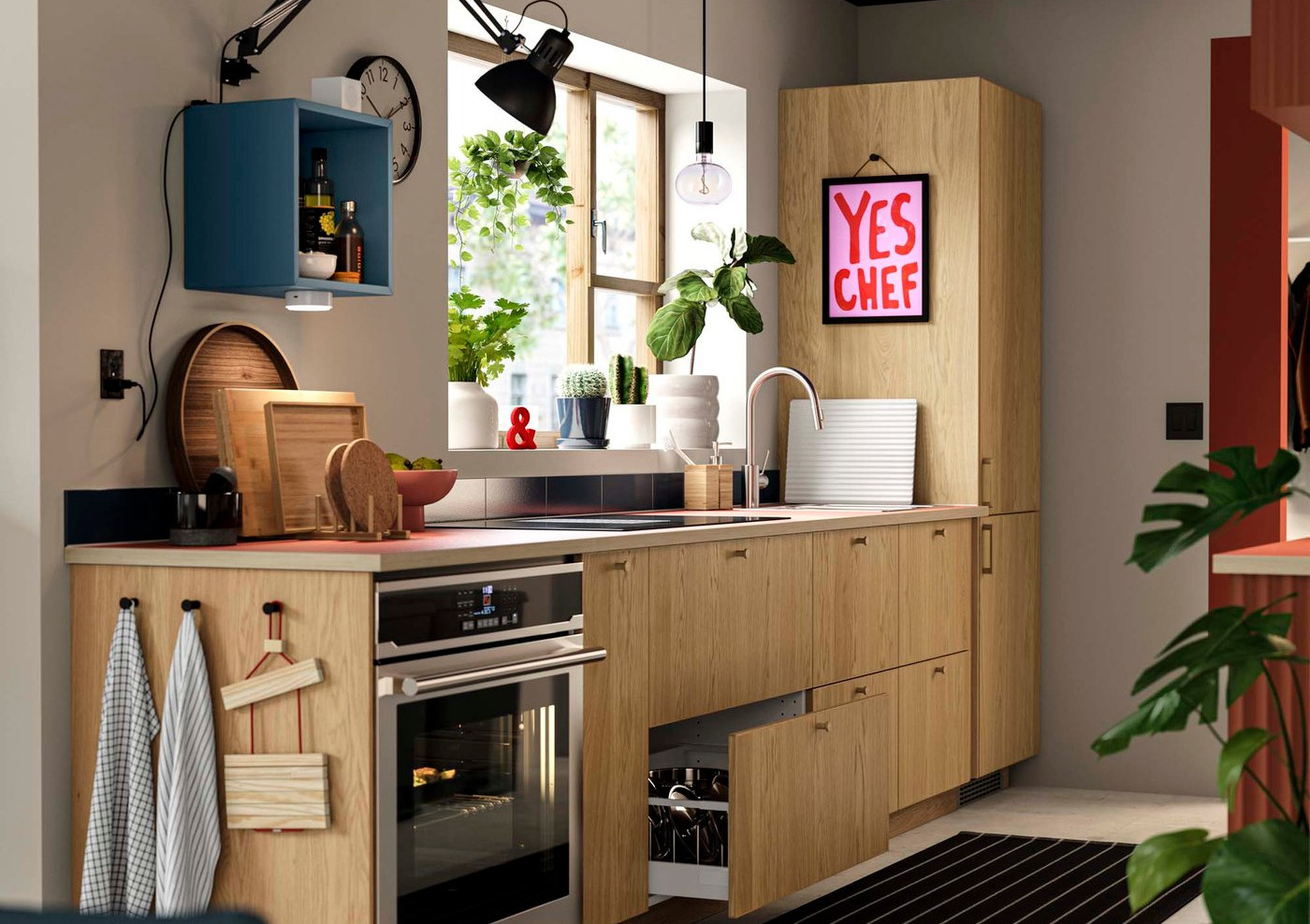
Are you feeling discouraged by your tiny kitchen and thinking you’ll NEVER be able to make it work? Not at all! A kitchen just a few square meters in size can be just as pleasant as a large one! This small IKEA designer kitchen is proof of that. With wavy-patterned cabinet fronts, a midnight blue ceiling, a built-in coffee nook, and a rolling cart serving as an accent piece, it’s close to perfection. The result challenges conventional wisdom about small spaces. We’ve drawn eight practical decorating lessons from this project, applicable to any compact kitchen.
The first design decision in a small kitchen is often the cabinet front. Here, the reddish-brown TERRSJÖ door with its embossed waves serves as the centerpiece. The pattern covers the tall cabinets and catches the eye as soon as you enter the room. Around this cabinet front, everything else remains understated: white on the base cabinets, light oak on the other doors, and a matte countertop.
This approach works precisely because it focuses the decorative intent on a single strong element. In a small space, too many details cancel each other out. A single well-chosen detail, on the other hand, makes a real impact. The TERRSJÖ cabinet door illustrates this well because it’s not just a door, it defines the kitchen’s identity.
Few people dare to paint the ceiling of a small kitchen midnight blue. And yet, this decision transforms the atmosphere more effectively than new tilework. The color visually draws surfaces closer together, creates a sense of intimacy, and adds depth to the overall space. Paired with the light oak of the SINARP cabinet fronts and the white of the cabinet bodies, the blue stands out as a striking decorative element through its contrast.
It’s a technique that interior designers regularly apply in small rooms, but one that homeowners are hesitant to adopt. The classic fear is that it will make the space feel heavy. The reality, when the color palette is well-balanced, is that a colored ceiling actually gives the impression that the space is well-controlled. This kitchen demonstrates this better than any explanation.
When counter space is limited, the wall shelf steps in. A dark gray-blue EKET unit, mounted above the backsplash, holds olive oil, salt, and a few jars. Lighting positioned directly above highlights the unit’s dark hue against the light-colored wall.
This detail transforms ordinary storage into a visual composition. It’s for storage, certainly, but it’s also for display. The selection of items placed on the shelf becomes a decorative choice in its own right: a bottle of quality olive oil, a small ceramic jar, a pot planted with herbs. (Editor’s note: it’s best to choose carefully what you put there, because it’s not just functional, it’s also decorative.)
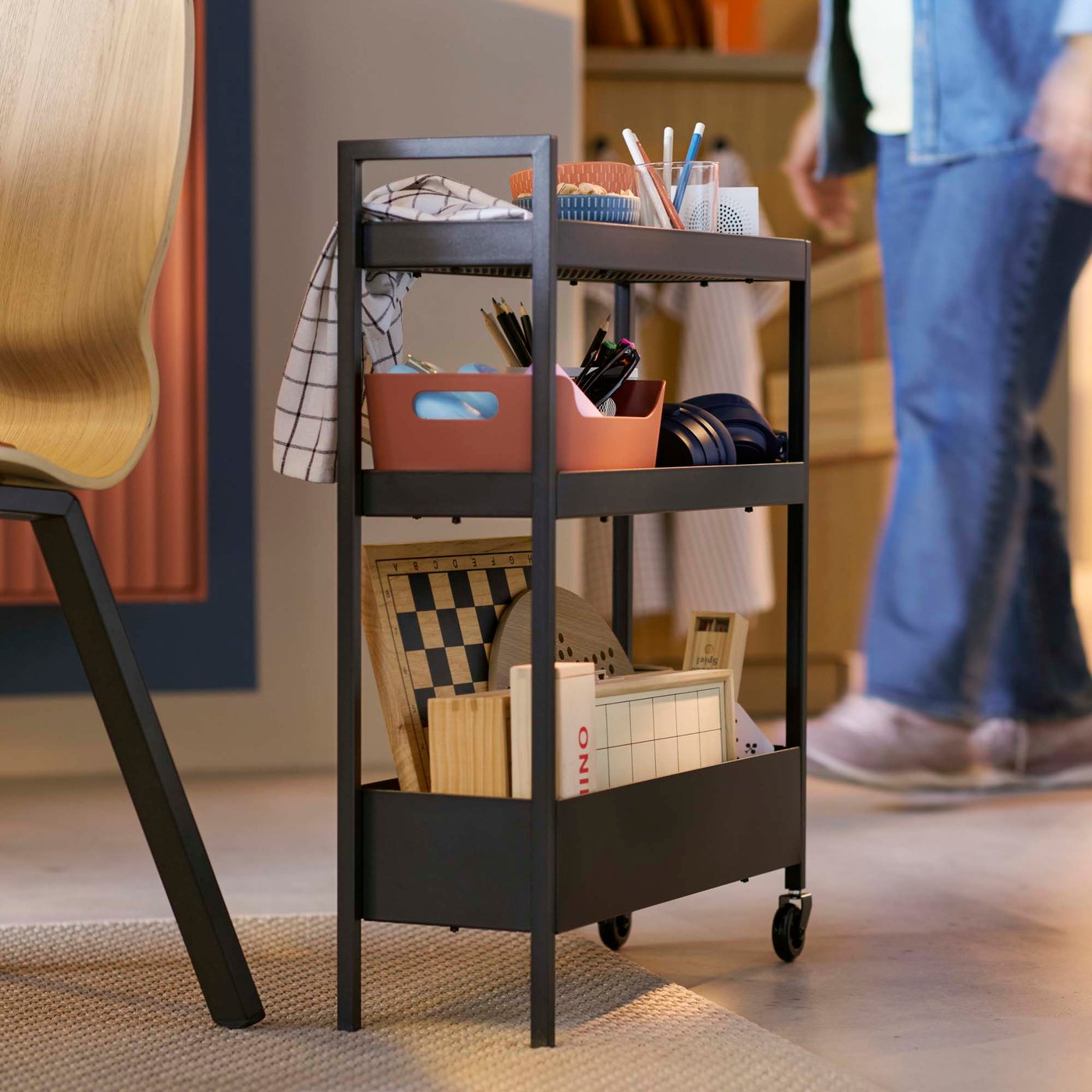
The NISSAFORS cart deserves its success. Hundreds, even thousands, are sold every year. Sleek, mobile, and available in metal in various colors, it glides between furniture and keeps your accessories within reach. In this kitchen, it’s used to store board games, cookbooks, and little treats. It rolls right up to the table in seconds when it’s time for a snack. It’s a functional accessory that also knows how to stay discreet (unless you choose it in green, like this year!).
The sides of upper cabinets remain bare in the vast majority of kitchens. It’s a forgotten surface, yet one that’s easily put to use. A few BAGGANÄS hooks are all it takes to transform them into practical storage, where you can hang dish towels, oven mitts, a small cutting board, or even a framed poster or a plant.
This detail significantly changes how the space is perceived. The kitchen is no longer just a series of closed doors. It opens up on the sides, becoming personalized right down to its corners. And visually, these hanging elements break up the monotonous verticality of the tall cabinets. A decorative result achieved with just a few euros and a screwdriver.
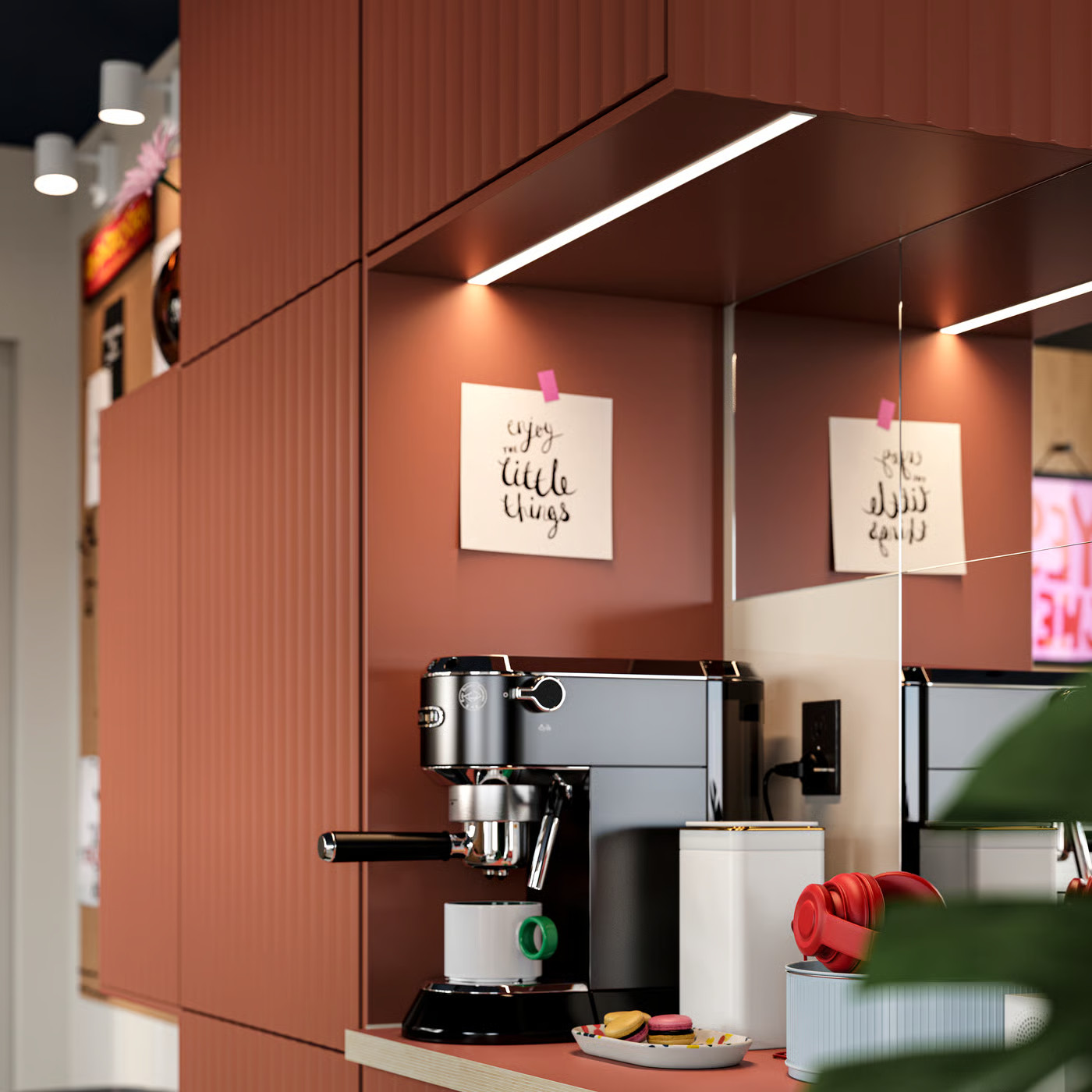
The MITTLED LED strip, dimmable and discreet, changes the ambiance depending on the time of day and your needs. During the day, it effectively illuminates the countertop for effortless cooking without casting shadows. In the evening, dimmed, it highlights the cookbooks displayed prominently, small objects, and a collection of carefully aligned cups.
It’s the same setup that guides you through a complex recipe in the evening and creates a warm, inviting scene after dinner. This type of lighting transforms a technical solution into a true design choice. Ideally, install a separate switch for this LED strip, independent of the ceiling light, to easily adjust the atmosphere.
A coffee corner designed as a space in its own right completely changes the experience of a compact kitchen. In this design, a niche is created by the asymmetrical offset of the upper cabinets. The espresso machine finds its natural place there, cups line up on an open shelf just above, and cookies disappear into a small, closed cabinet within easy reach.
This micro-space has its own logic. In the morning, you know exactly where to go, what to do, and in what order. This organization, both decorative and functional, responds to a real underlying trend: transforming the kitchen into a complete living space, not just a place for preparing meals. The coffee corner is the most accessible expression of this.
A reddish-brown wavy cabinet front, light oak wood, blue paint on the ceiling, a matte countertop, it’s the mix of materials that gives this ensemble its richness. Each surface plays a different role in the overall composition. The TERRSJÖ door adds texture and movement. The oak of the SINARP brings the warmth of raw wood. White of the cabinets visually lightens the mass of the upper cabinets.
The whole design works thanks to a deliberately limited color palette. We use two neutral shades and one bold color. This is the rule that prevents visual clutter in small spaces. We don’t just pile on materials without a unifying theme; we select them so they complement each other. This kitchen clearly demonstrates that.
Space constraints force you to make choices. And in interior design, choosing often means giving something up (in real life, too, for that matter). But here, this small IKEA designer kitchen doesn’t do things by halves. A graphic door with real personality, a colorful ceiling, well-adjusted lighting, a few hooks on the sides of the cabinets, every detail counts double when space is limited.
This IKEA design reminds us of a simple truth we too often forget. Budget and space constraints don’t mean you have to settle for austerity. They simply require you to think carefully before buying, to figure out what the best solution will be. The result here speaks for itself, because this kitchen makes you want to stay (and, incidentally, cook - laughs - ).
The US now has around 60 IKEA stores, spread across more than 30 states. That's a lot of blue-and-yellow warehouses, yet the real footprint goes well beyond square footage. When IKEA opened its first American location in Plymouth Meeting, Pennsylvania, in 1985, the country's dominant decorating logic was either inherited furniture or department store sets bought as a single package. IKEA broke both. It sold the idea that you could build a coherent, good-looking interior piece by piece, on a modest budget, and actually make decisions yourself about how it all fits together.
That shift mattered. The clean Scandinavian lines gradually moved from "budget option" to aspirational reference, showing up in apartment tours on YouTube, in staging for real estate listings, and eventually in the visual language of half the interior design accounts on Instagram. The SEKTION system, also adapted to local realities: larger kitchens, bigger cabinet formats, wider countertops. This compact TERRSJÖ and SINARP kitchen is proof that even with more square footage available, restraint and personality still win.

1. A graphic cabinet front to set the tone right from the start
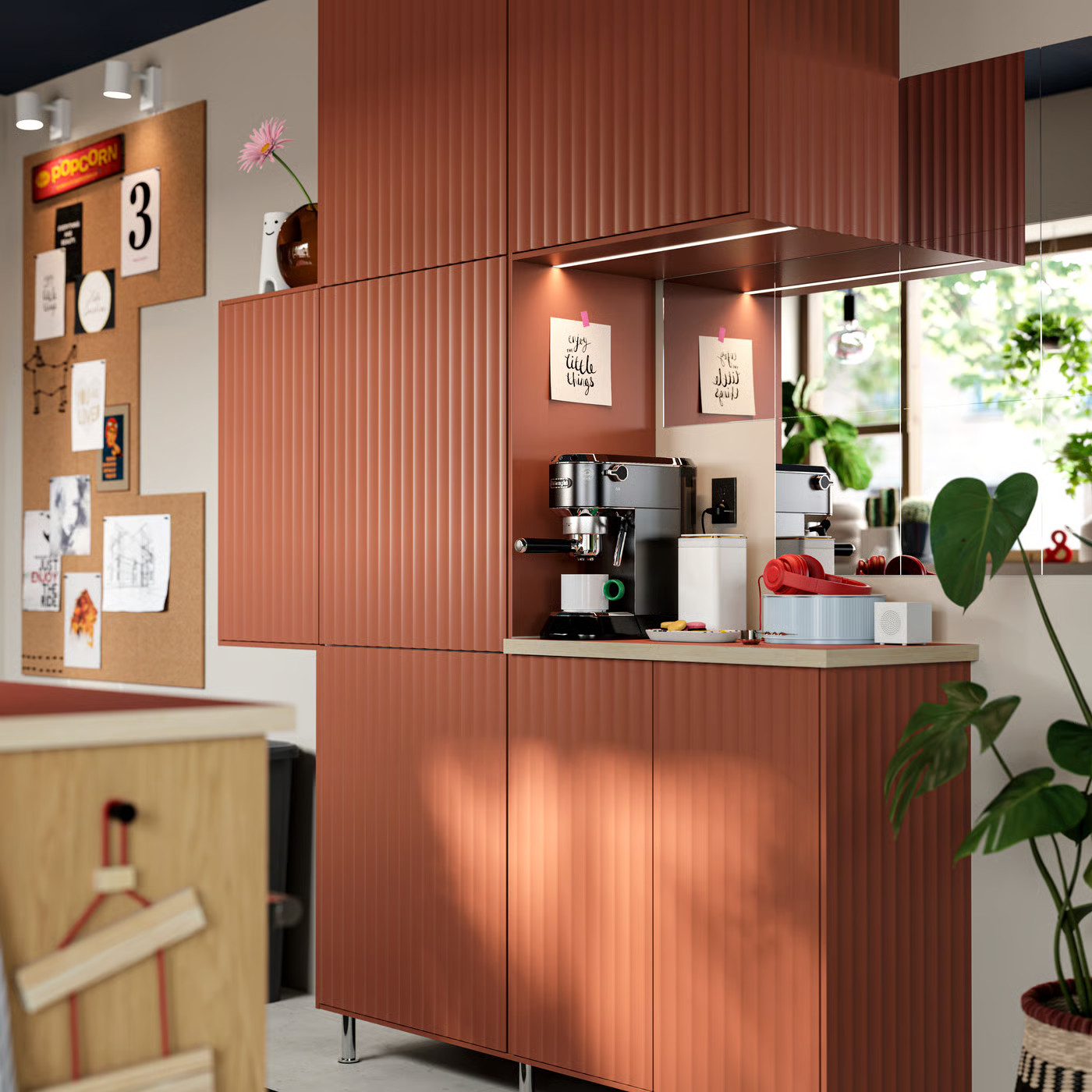
The first design decision in a small kitchen is often the cabinet front. Here, the reddish-brown TERRSJÖ door with its embossed waves serves as the centerpiece. The pattern covers the tall cabinets and catches the eye as soon as you enter the room. Around this cabinet front, everything else remains understated: white on the base cabinets, light oak on the other doors, and a matte countertop.
This approach works precisely because it focuses the decorative intent on a single strong element. In a small space, too many details cancel each other out. A single well-chosen detail, on the other hand, makes a real impact. The TERRSJÖ cabinet door illustrates this well because it’s not just a door, it defines the kitchen’s identity.
2. The colored ceiling, an underutilized space
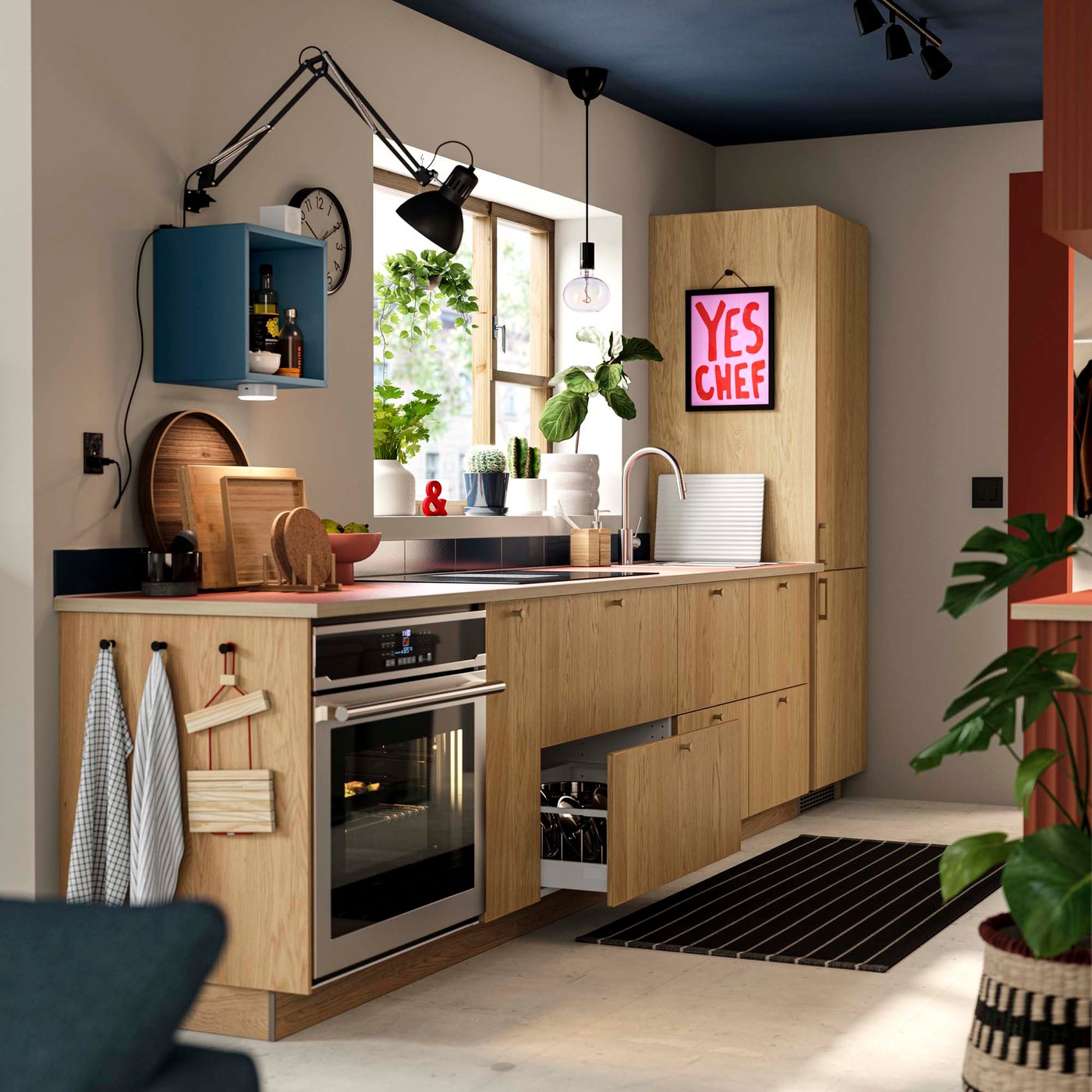
Few people dare to paint the ceiling of a small kitchen midnight blue. And yet, this decision transforms the atmosphere more effectively than new tilework. The color visually draws surfaces closer together, creates a sense of intimacy, and adds depth to the overall space. Paired with the light oak of the SINARP cabinet fronts and the white of the cabinet bodies, the blue stands out as a striking decorative element through its contrast.
It’s a technique that interior designers regularly apply in small rooms, but one that homeowners are hesitant to adopt. The classic fear is that it will make the space feel heavy. The reality, when the color palette is well-balanced, is that a colored ceiling actually gives the impression that the space is well-controlled. This kitchen demonstrates this better than any explanation.
3. The wall shelf, a blend of storage and visual composition
When counter space is limited, the wall shelf steps in. A dark gray-blue EKET unit, mounted above the backsplash, holds olive oil, salt, and a few jars. Lighting positioned directly above highlights the unit’s dark hue against the light-colored wall.
This detail transforms ordinary storage into a visual composition. It’s for storage, certainly, but it’s also for display. The selection of items placed on the shelf becomes a decorative choice in its own right: a bottle of quality olive oil, a small ceramic jar, a pot planted with herbs. (Editor’s note: it’s best to choose carefully what you put there, because it’s not just functional, it’s also decorative.)
4. The rolling cart, a piece of occasional furniture worth reviving
The NISSAFORS cart deserves its success. Hundreds, even thousands, are sold every year. Sleek, mobile, and available in metal in various colors, it glides between furniture and keeps your accessories within reach. In this kitchen, it’s used to store board games, cookbooks, and little treats. It rolls right up to the table in seconds when it’s time for a snack. It’s a functional accessory that also knows how to stay discreet (unless you choose it in green, like this year!).
5. Cabinet sides: overlooked decorative surfaces
The sides of upper cabinets remain bare in the vast majority of kitchens. It’s a forgotten surface, yet one that’s easily put to use. A few BAGGANÄS hooks are all it takes to transform them into practical storage, where you can hang dish towels, oven mitts, a small cutting board, or even a framed poster or a plant.
This detail significantly changes how the space is perceived. The kitchen is no longer just a series of closed doors. It opens up on the sides, becoming personalized right down to its corners. And visually, these hanging elements break up the monotonous verticality of the tall cabinets. A decorative result achieved with just a few euros and a screwdriver.
6. LED lighting under upper cabinets: both practical and decorative
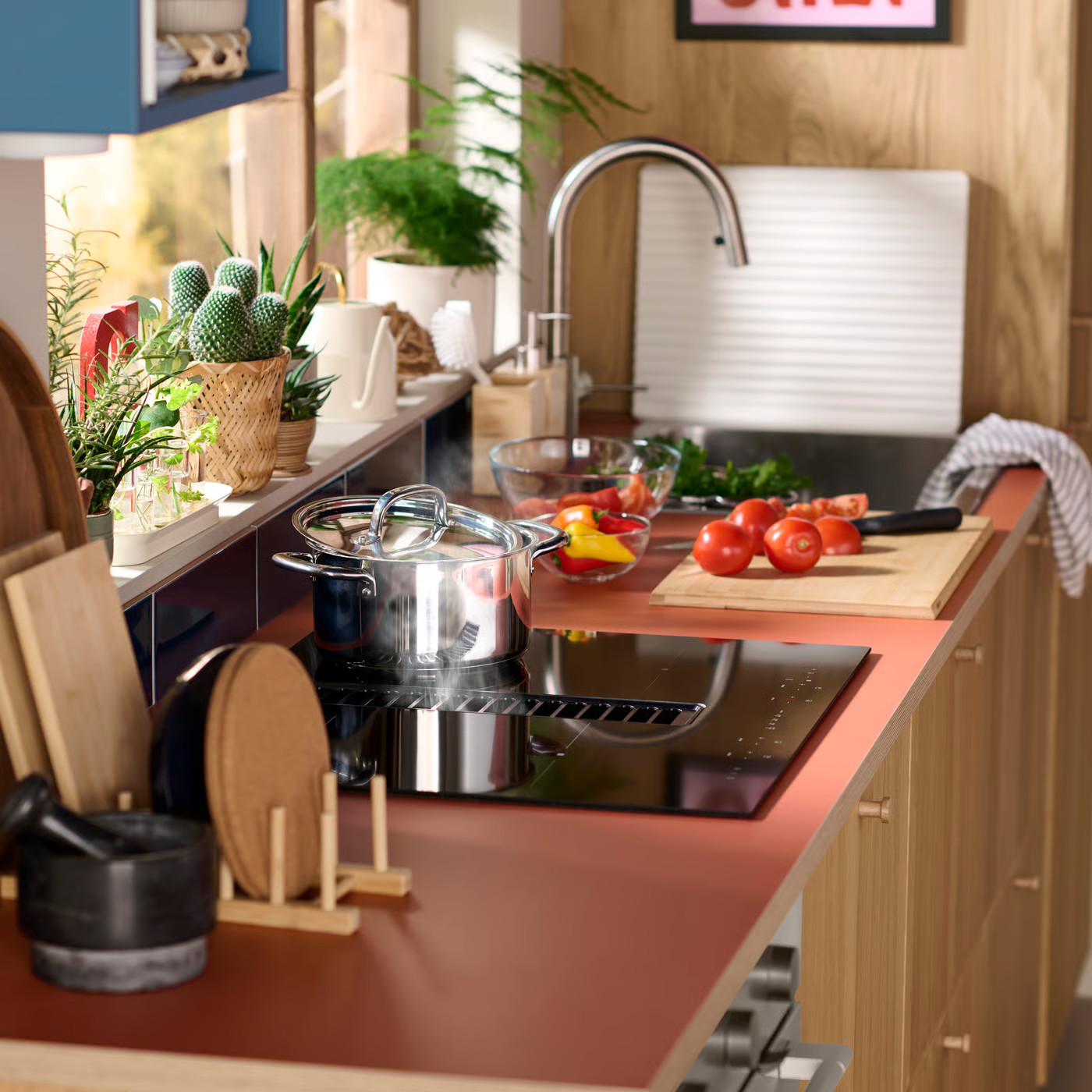
The MITTLED LED strip, dimmable and discreet, changes the ambiance depending on the time of day and your needs. During the day, it effectively illuminates the countertop for effortless cooking without casting shadows. In the evening, dimmed, it highlights the cookbooks displayed prominently, small objects, and a collection of carefully aligned cups.
It’s the same setup that guides you through a complex recipe in the evening and creates a warm, inviting scene after dinner. This type of lighting transforms a technical solution into a true design choice. Ideally, install a separate switch for this LED strip, independent of the ceiling light, to easily adjust the atmosphere.
7. The coffee corner, a room within a room
A coffee corner designed as a space in its own right completely changes the experience of a compact kitchen. In this design, a niche is created by the asymmetrical offset of the upper cabinets. The espresso machine finds its natural place there, cups line up on an open shelf just above, and cookies disappear into a small, closed cabinet within easy reach.
This micro-space has its own logic. In the morning, you know exactly where to go, what to do, and in what order. This organization, both decorative and functional, responds to a real underlying trend: transforming the kitchen into a complete living space, not just a place for preparing meals. The coffee corner is the most accessible expression of this.
8. Mixing materials to avoid monotony
A reddish-brown wavy cabinet front, light oak wood, blue paint on the ceiling, a matte countertop, it’s the mix of materials that gives this ensemble its richness. Each surface plays a different role in the overall composition. The TERRSJÖ door adds texture and movement. The oak of the SINARP brings the warmth of raw wood. White of the cabinets visually lightens the mass of the upper cabinets.
The whole design works thanks to a deliberately limited color palette. We use two neutral shades and one bold color. This is the rule that prevents visual clutter in small spaces. We don’t just pile on materials without a unifying theme; we select them so they complement each other. This kitchen clearly demonstrates that.
Our take on this small IKEA designer kitchen
Space constraints force you to make choices. And in interior design, choosing often means giving something up (in real life, too, for that matter). But here, this small IKEA designer kitchen doesn’t do things by halves. A graphic door with real personality, a colorful ceiling, well-adjusted lighting, a few hooks on the sides of the cabinets, every detail counts double when space is limited.
This IKEA design reminds us of a simple truth we too often forget. Budget and space constraints don’t mean you have to settle for austerity. They simply require you to think carefully before buying, to figure out what the best solution will be. The result here speaks for itself, because this kitchen makes you want to stay (and, incidentally, cook - laughs - ).
IKEA in the US: how a Swedish brand rewired American home décor
The US now has around 60 IKEA stores, spread across more than 30 states. That's a lot of blue-and-yellow warehouses, yet the real footprint goes well beyond square footage. When IKEA opened its first American location in Plymouth Meeting, Pennsylvania, in 1985, the country's dominant decorating logic was either inherited furniture or department store sets bought as a single package. IKEA broke both. It sold the idea that you could build a coherent, good-looking interior piece by piece, on a modest budget, and actually make decisions yourself about how it all fits together.
That shift mattered. The clean Scandinavian lines gradually moved from "budget option" to aspirational reference, showing up in apartment tours on YouTube, in staging for real estate listings, and eventually in the visual language of half the interior design accounts on Instagram. The SEKTION system, also adapted to local realities: larger kitchens, bigger cabinet formats, wider countertops. This compact TERRSJÖ and SINARP kitchen is proof that even with more square footage available, restraint and personality still win.


Comments