When a 19th-century English cottage becomes a lesson in contemporary architecture
Follow Planète Déco on Google — add us to your favourites to keep our decor articles in your news feedDiscover Folly Cottage, a 19th-century English cottage transformed by the firm Invisible Studio, featuring a charred wood extension
On the border of Hampshire and Surrey, where the bucolic fields of rural England gradually give way to heathland, lies a property worth stopping for. Folly Cottage isn’t a house you can see from the road. You discover it at the end of a flower-lined driveway, gradually, and this approach sets the tone. This 19th-century English cottage has been given a new lease on life following its brilliant transformation by an architectural firm.
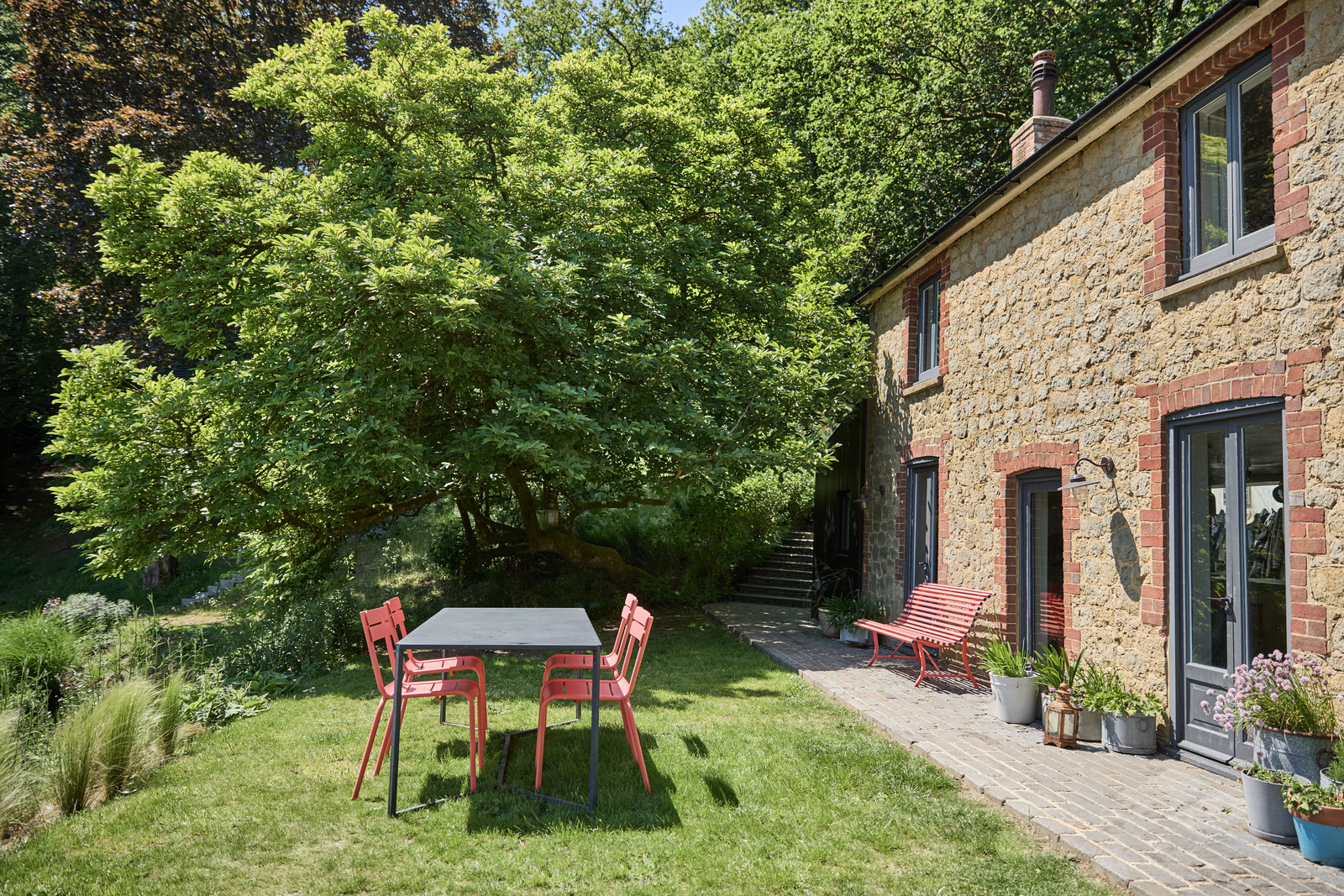
The story begins in 1802 with a solid, modest stone worker’s cottage, built with no ambition other than to shelter simple lives. Two centuries later, the London-based firm Invisible Studio, winner of the RIBA Prize, received a unique commission. It was tasked with transforming the property into a 21st-century home without betraying its working-class heritage.
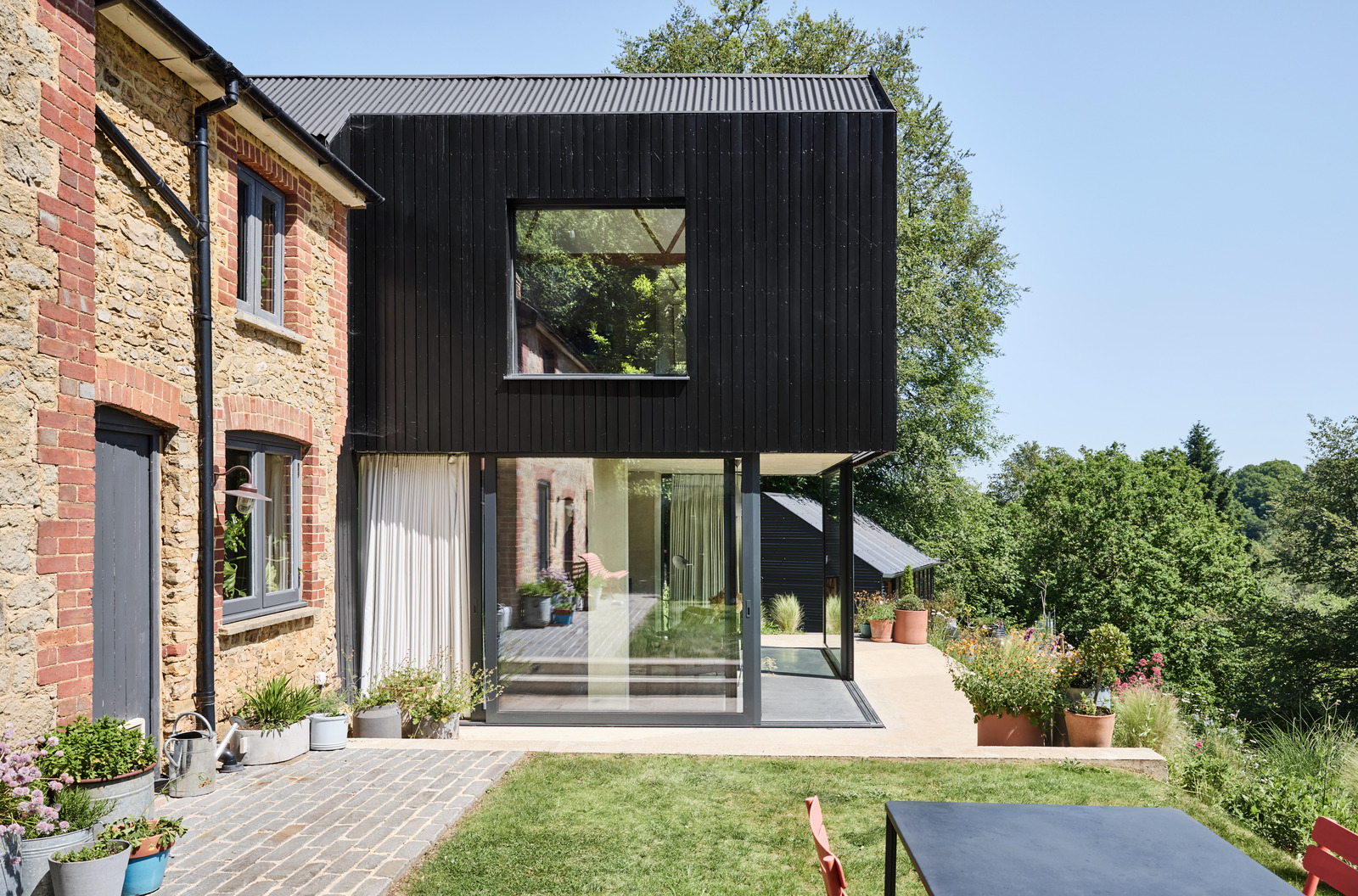
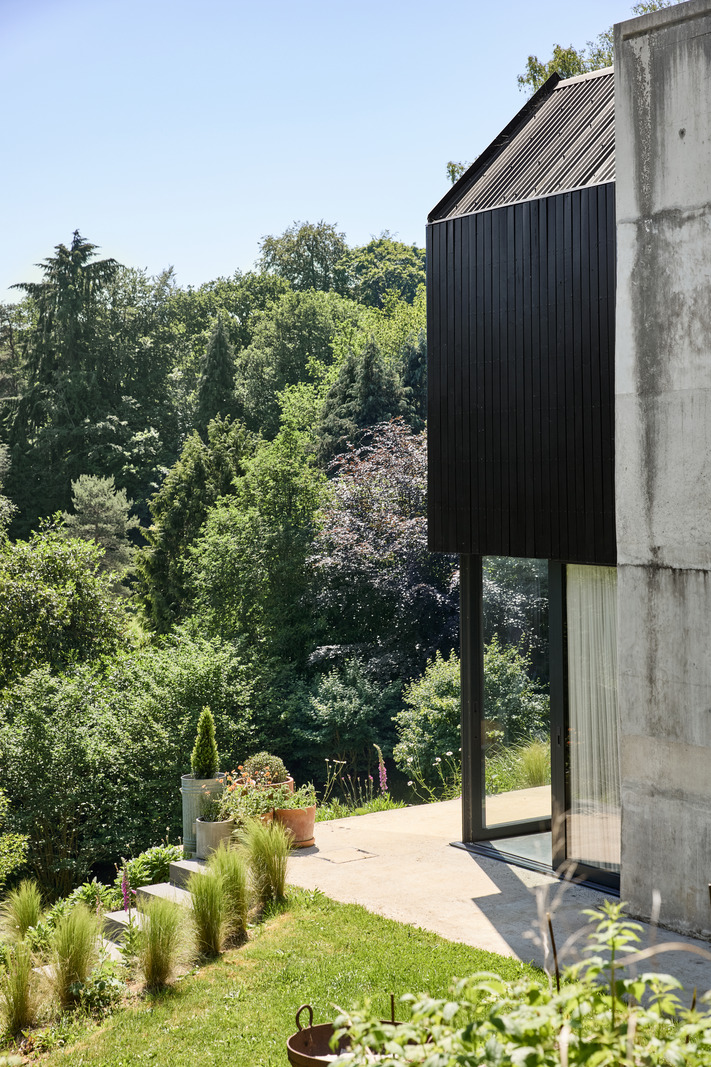
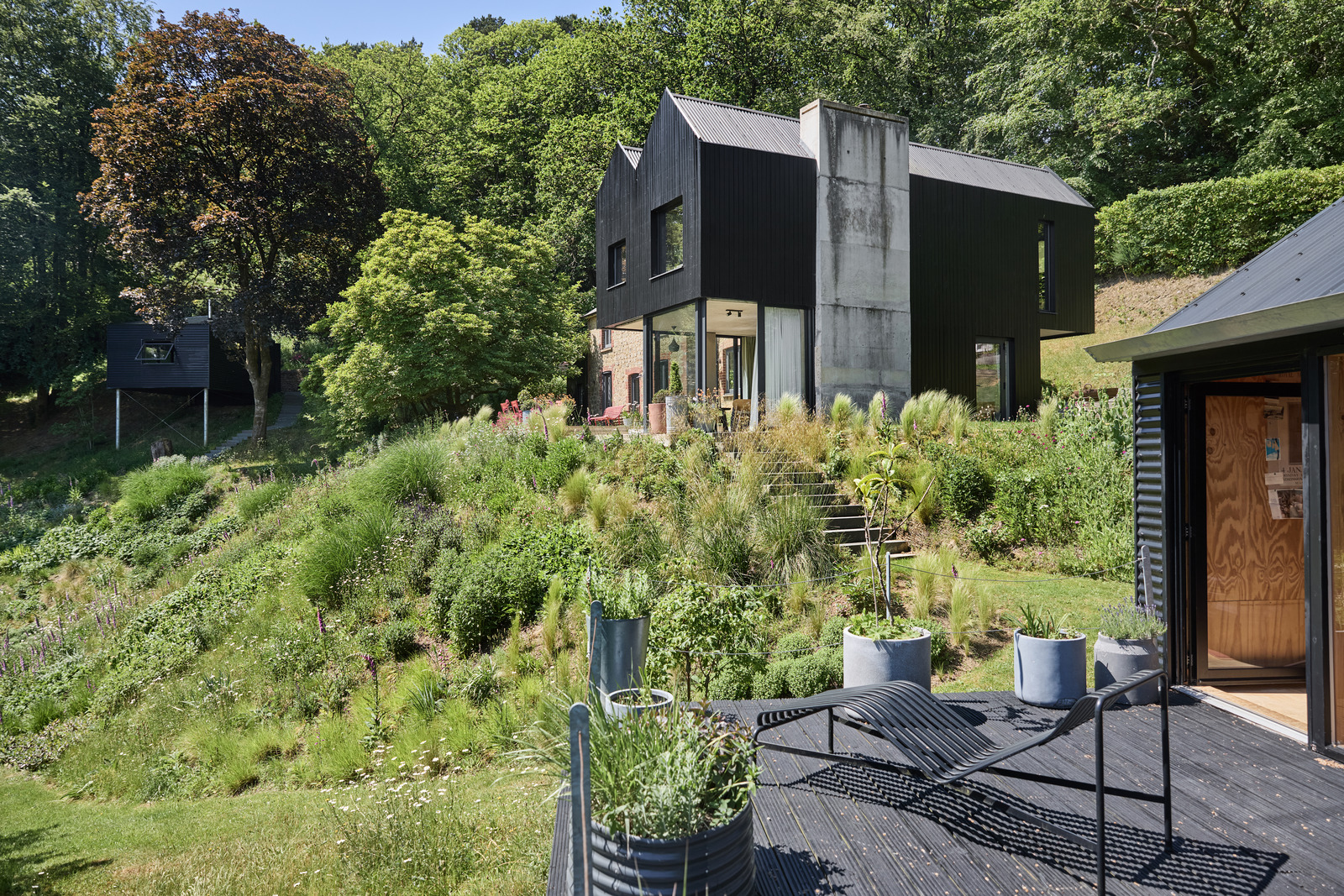
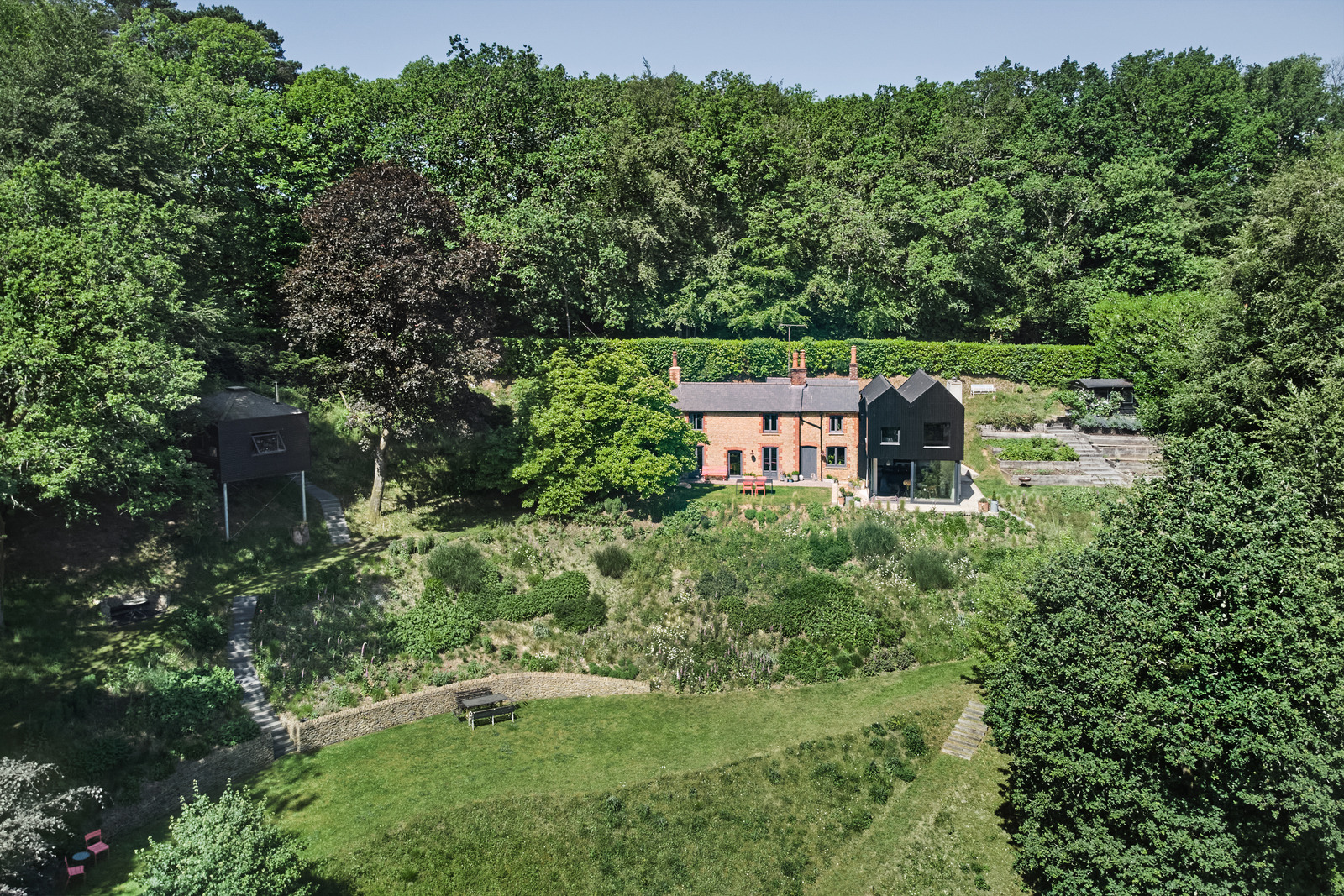
The result is immediately apparent as soon as you arrive on the garden side. A contemporary extension, clad in charred wood using the Sho Sugi Ban technique, rises perpendicular to the original cottage. The contrast between the ochre stone and red bricks on one side, and the matte black volume on the other, is stark. Yet, far from being jarring, it is original and innovative. The extension’s gabled roof mirrors the original’s profile, and this continuity of silhouette is enough to reconcile the two eras. From the garden, the eye moves seamlessly from one to the other.
This type of intervention is characteristic of Invisible Studio’s approach. The studio often works with raw materials, wood, earth, hemp, stone, and here, concrete takes center stage.
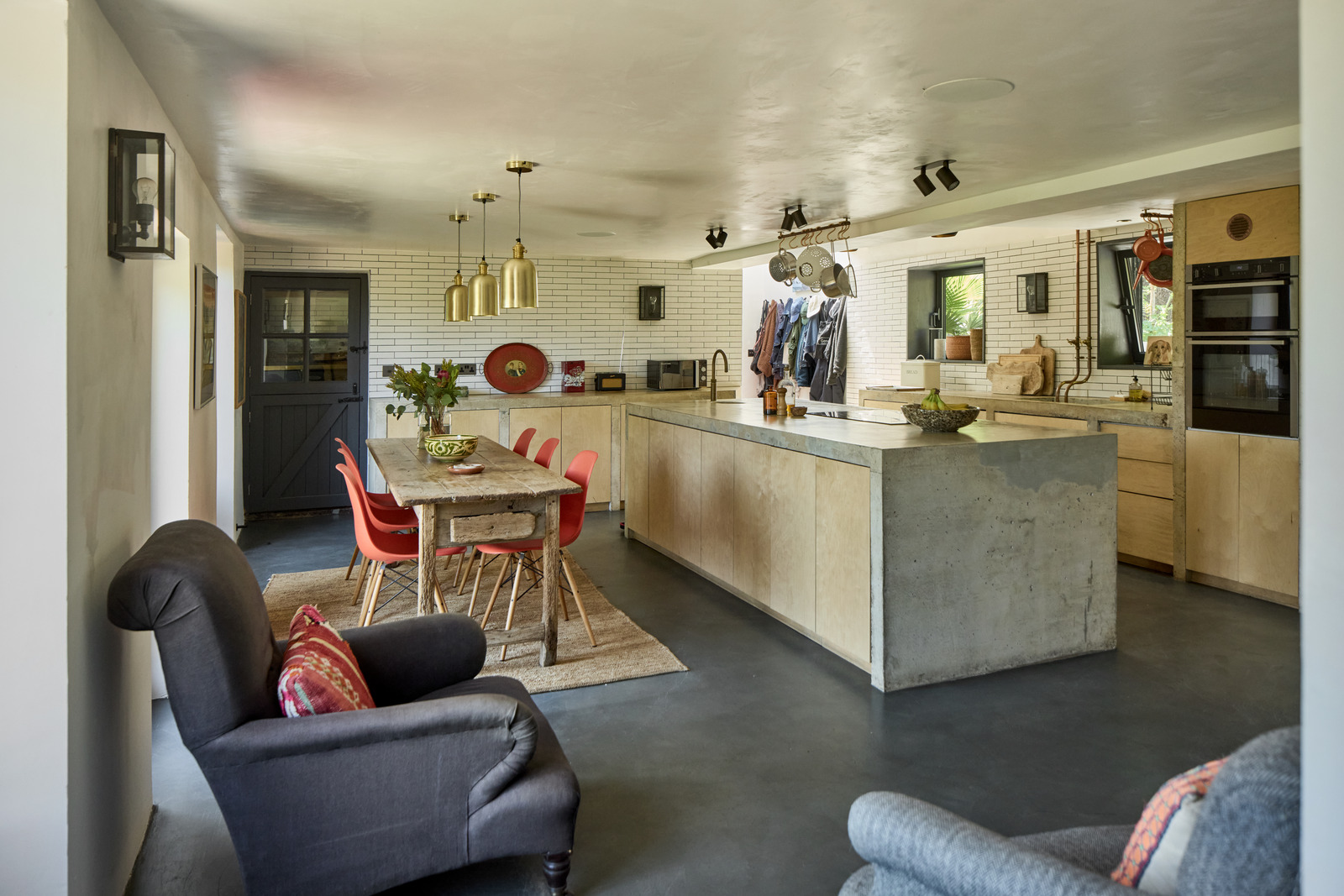
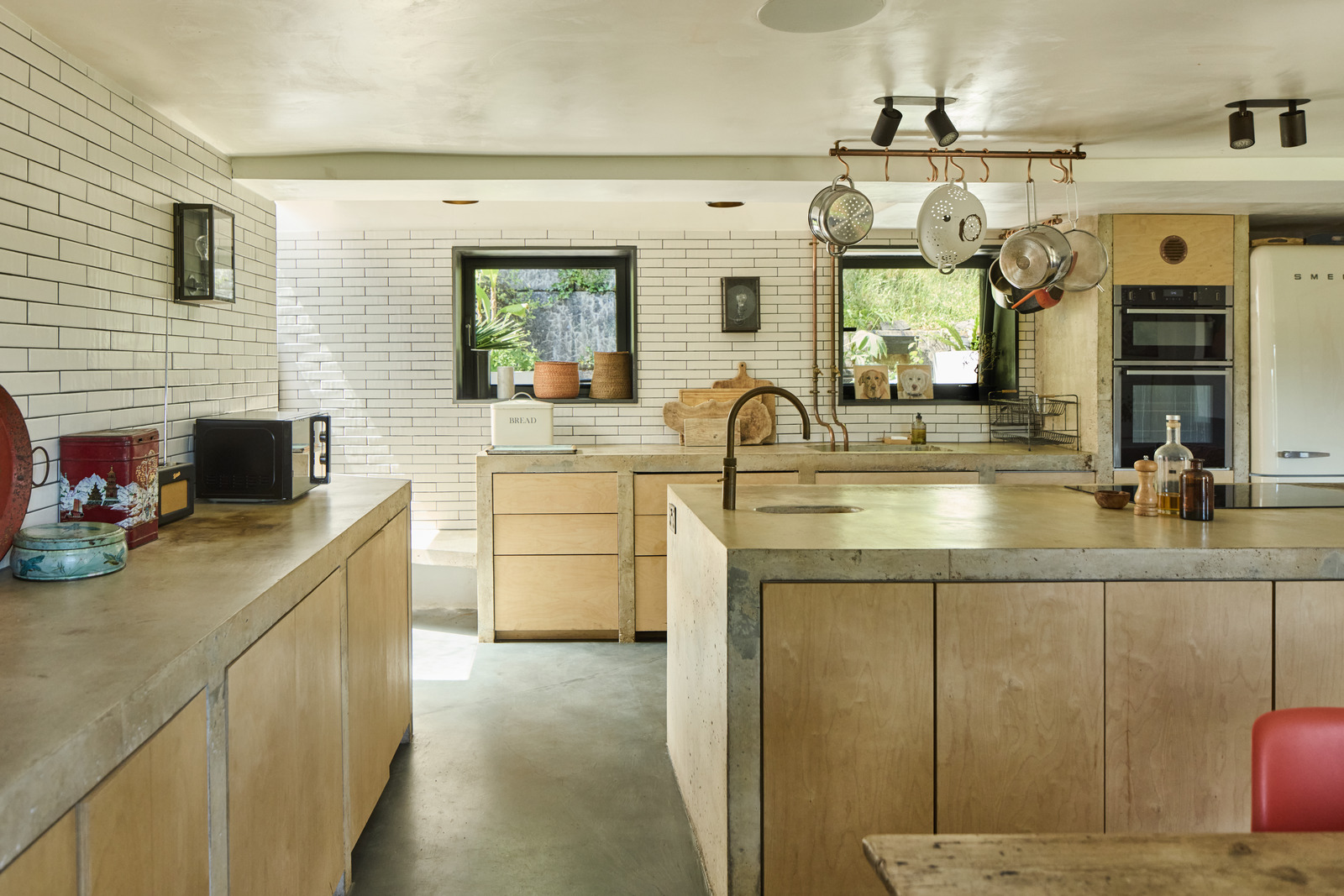
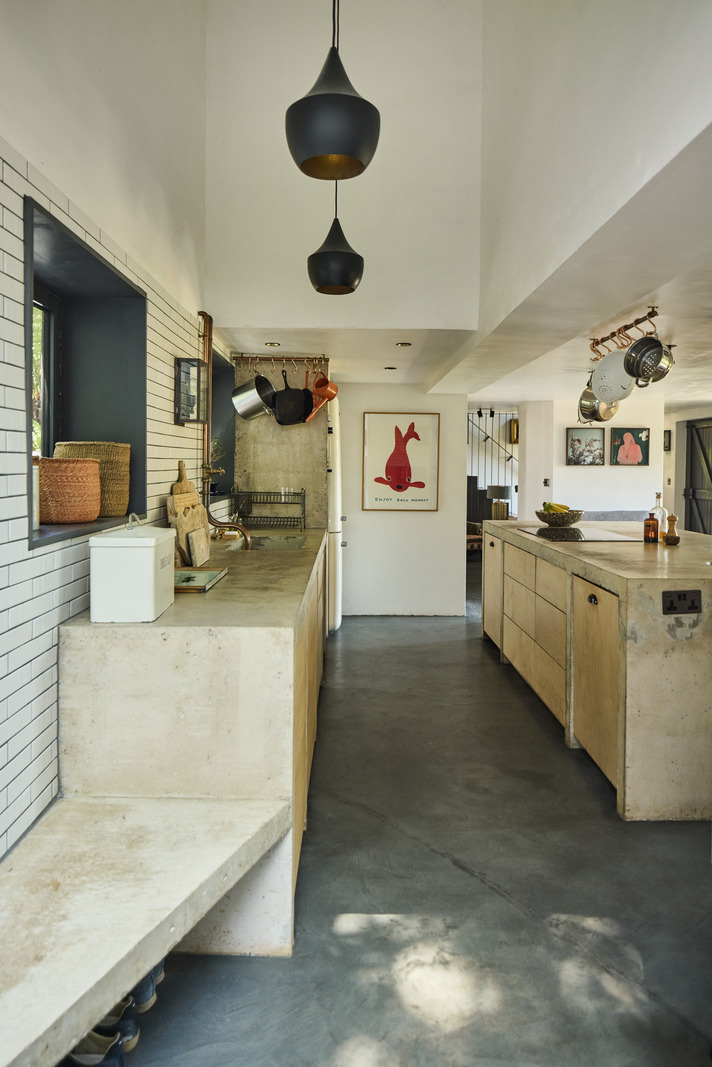
You enter through a functional porch. The kitchen is immediately on your left, and there, the tone shifts. The light-wood-colored cabinets are complemented by poured-in-place concrete countertops with a slightly irregular texture.
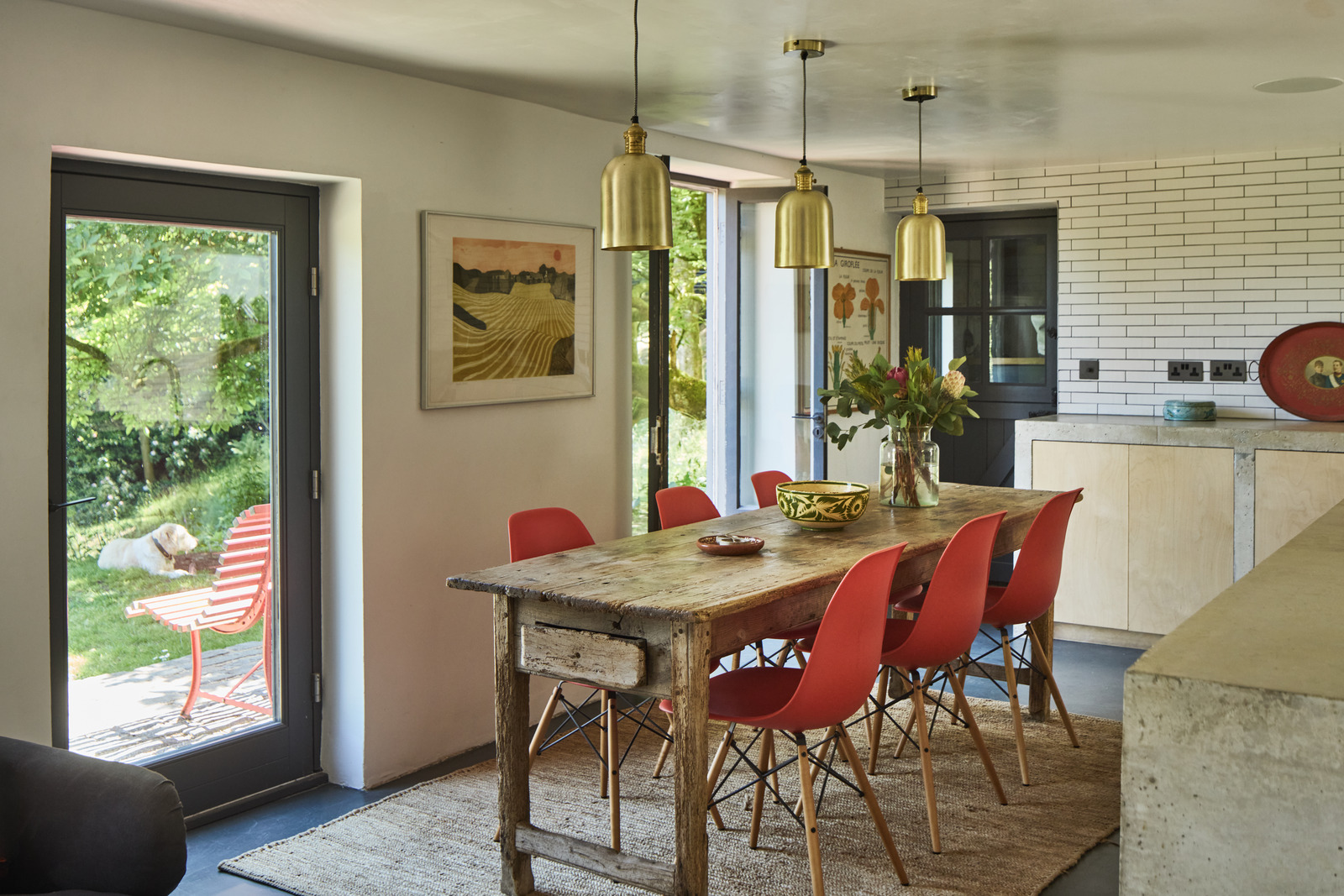
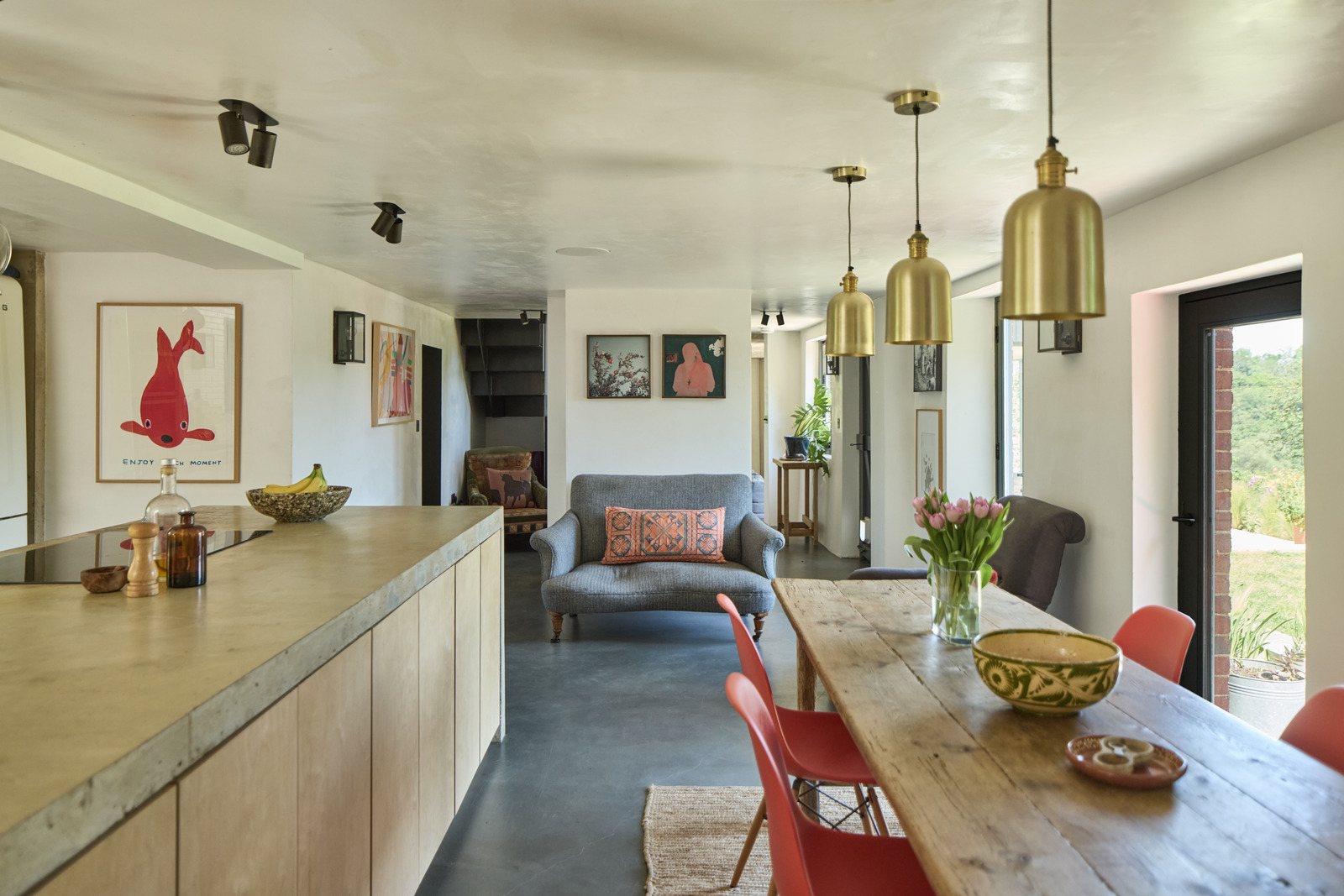
Two matte gold brass pendant lights hang above the dining table, an antique table made of raw wood surrounded by poppy-red Eames chairs. This contrast, a weathered farmhouse table paired with iconic designer chairs, is a decorative concept we often see, and it works well despite the seemingly opposing styles.
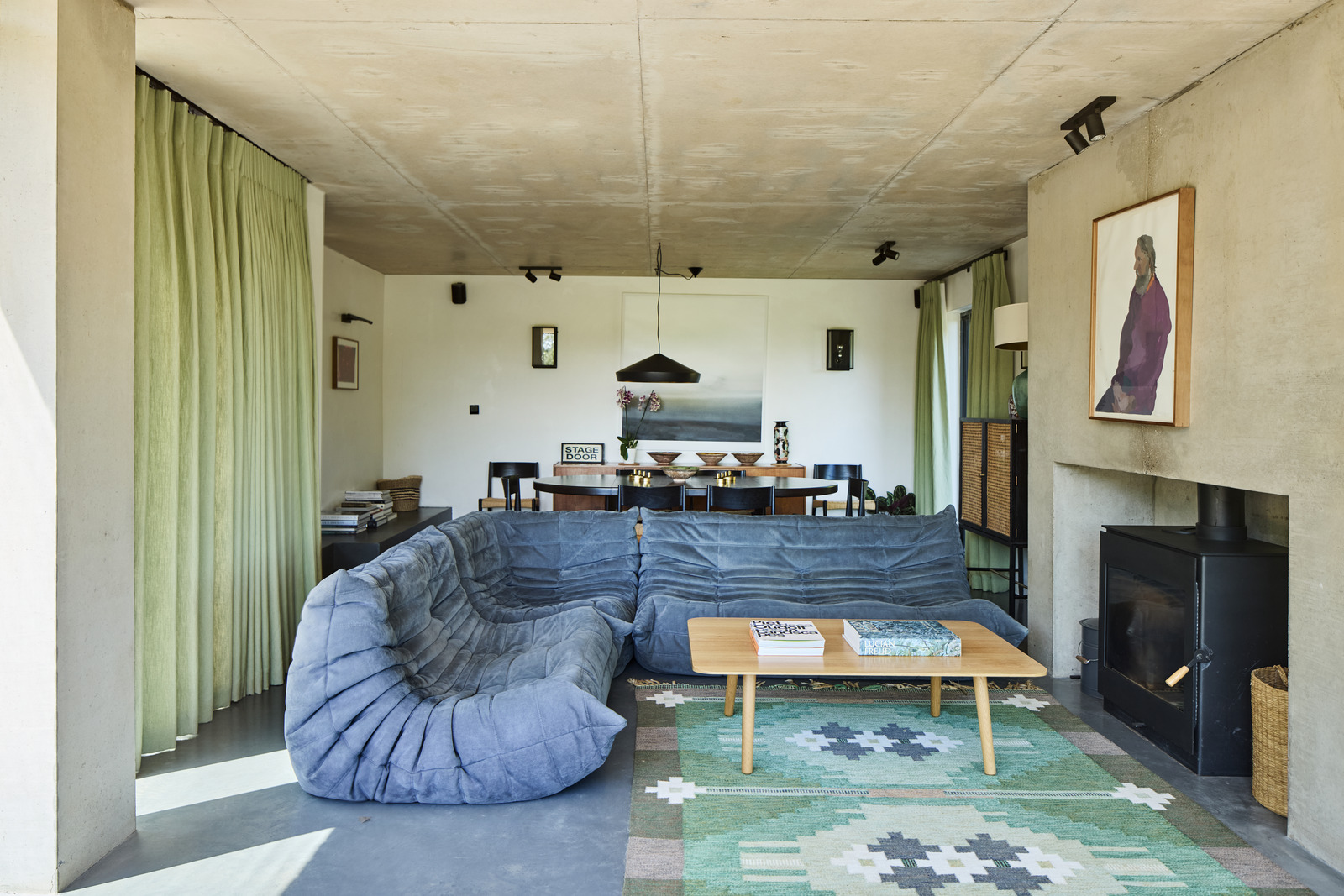
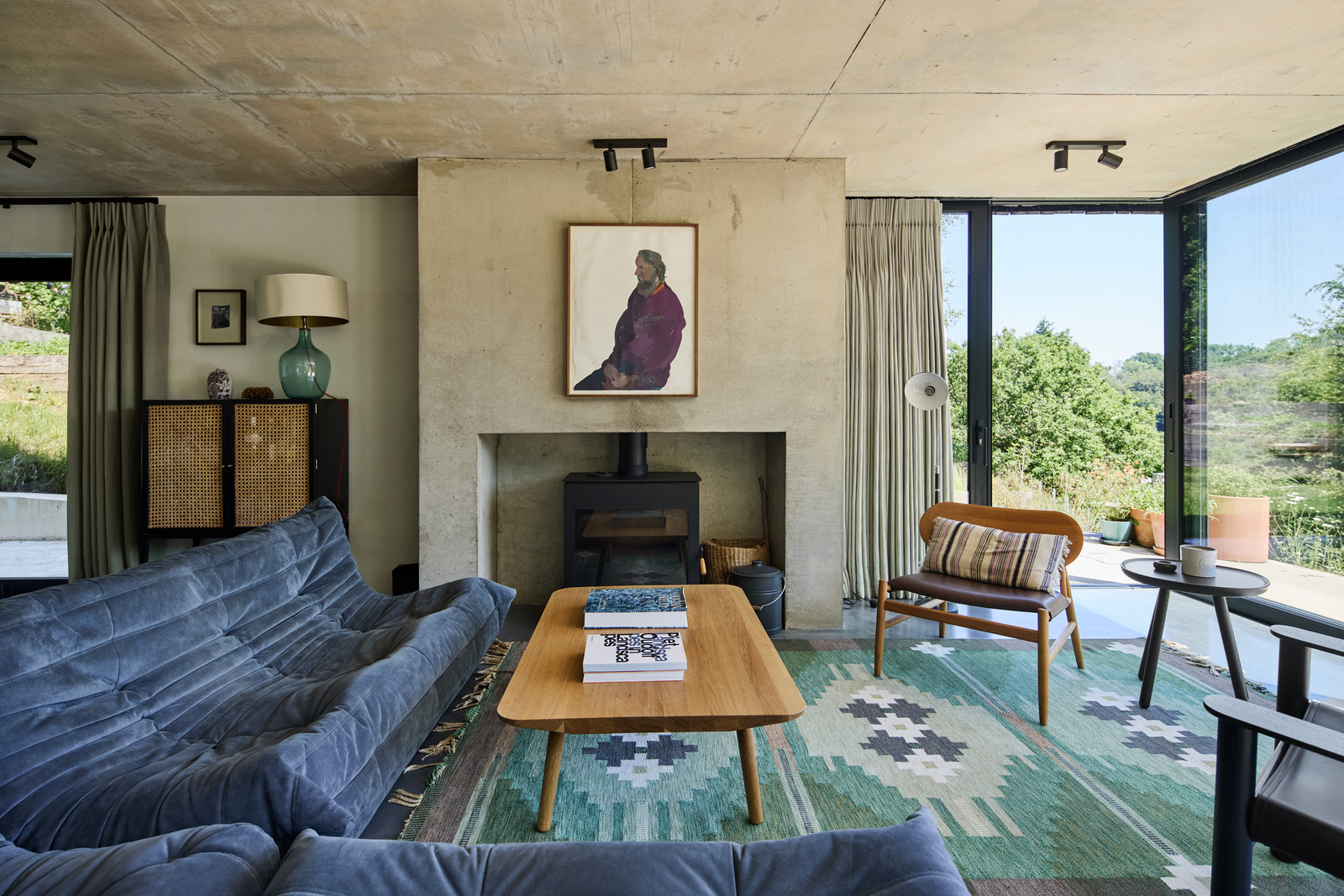
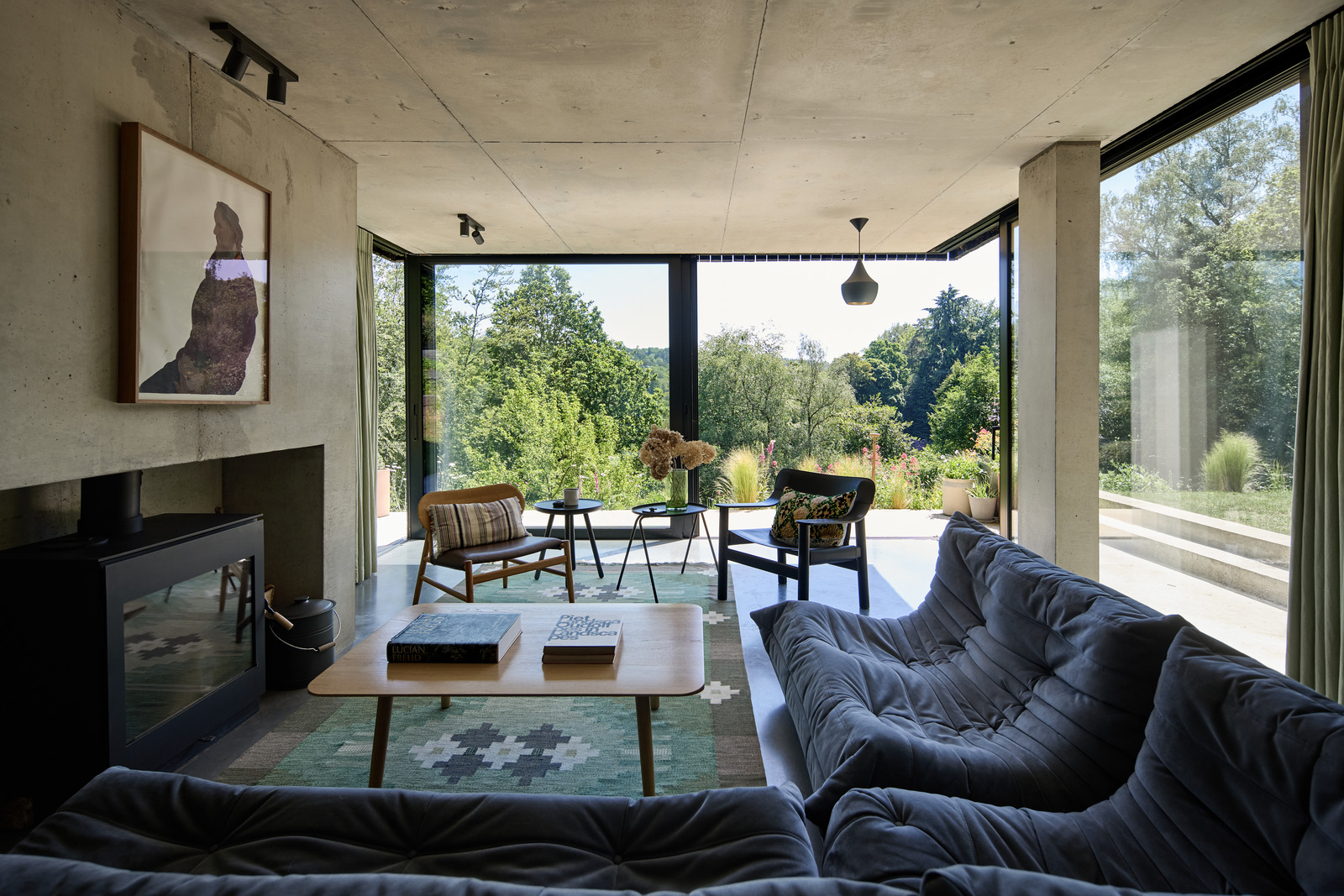
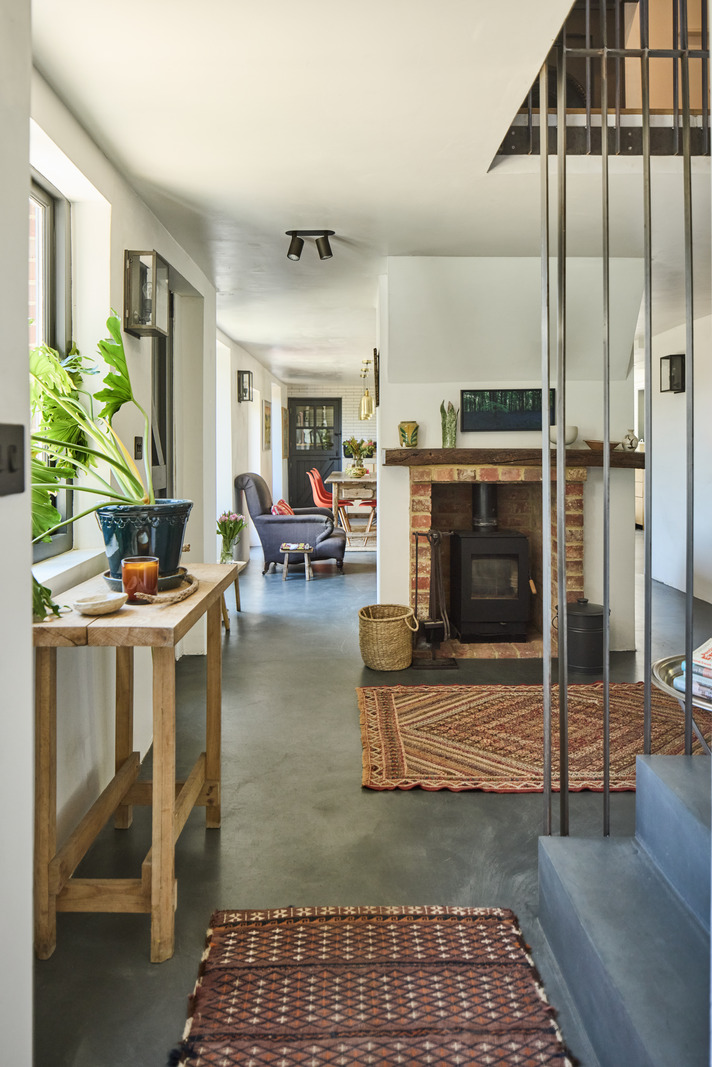
Its polished concrete floor continues throughout the living space. The living room, set slightly lower, is furnished with a Togo sofa in blue-gray velvet, one of the classics of French design by Michel Ducaroy for Ligne Roset. The kilim rug in shades of green and gray adds an ethnic touch. Two wood-burning stoves,one built into a sculpted concrete wall, the other placed in a corner, warm this large, bright room.
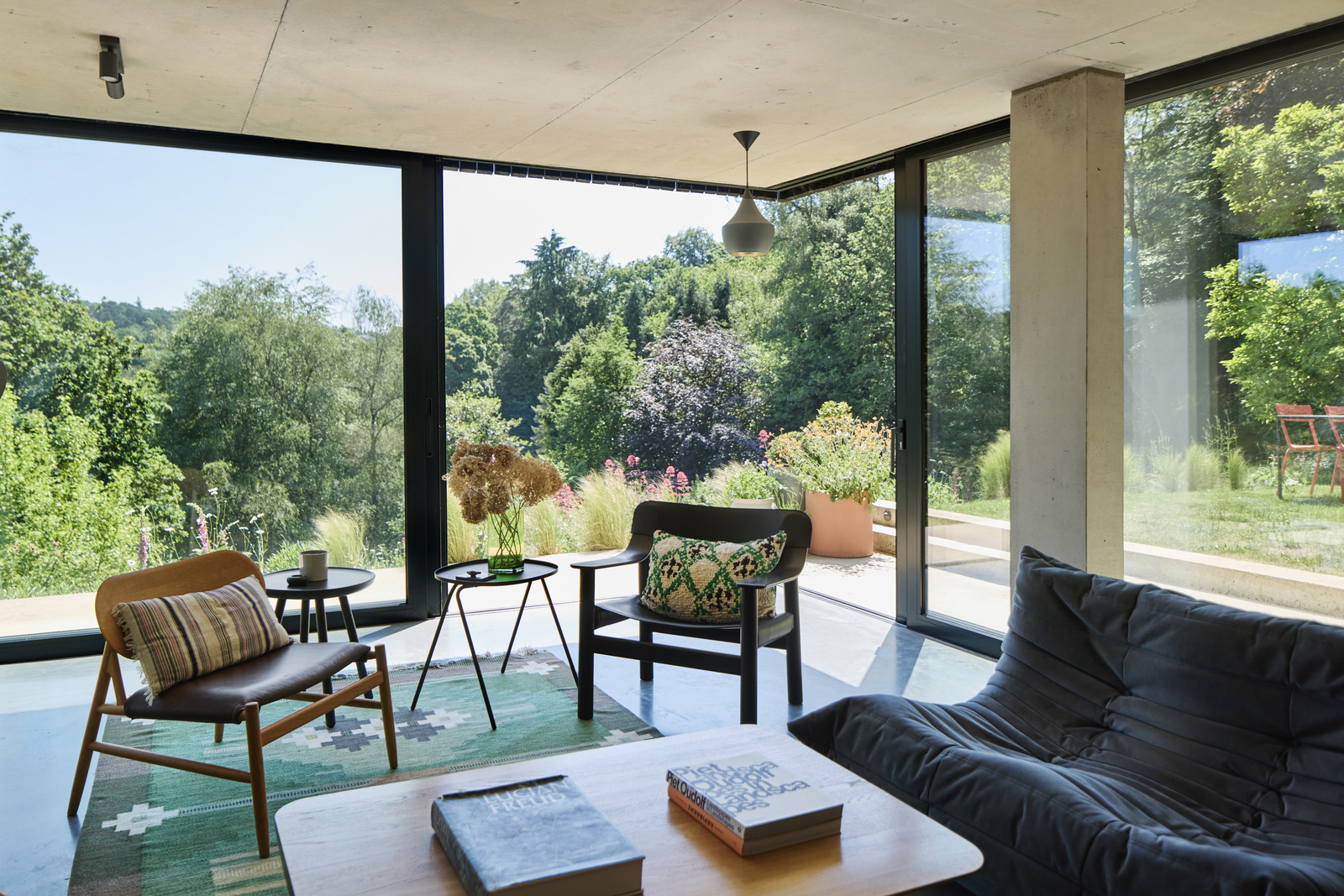
The large sliding glass doors that open the living room onto the garden offer a view of the trees and the magnificent garden designed by landscape architect Sam Ovens. They allow the vegetation to visually flow into the house. This room is like a luminous box that blurs the boundaries between inside and outside.
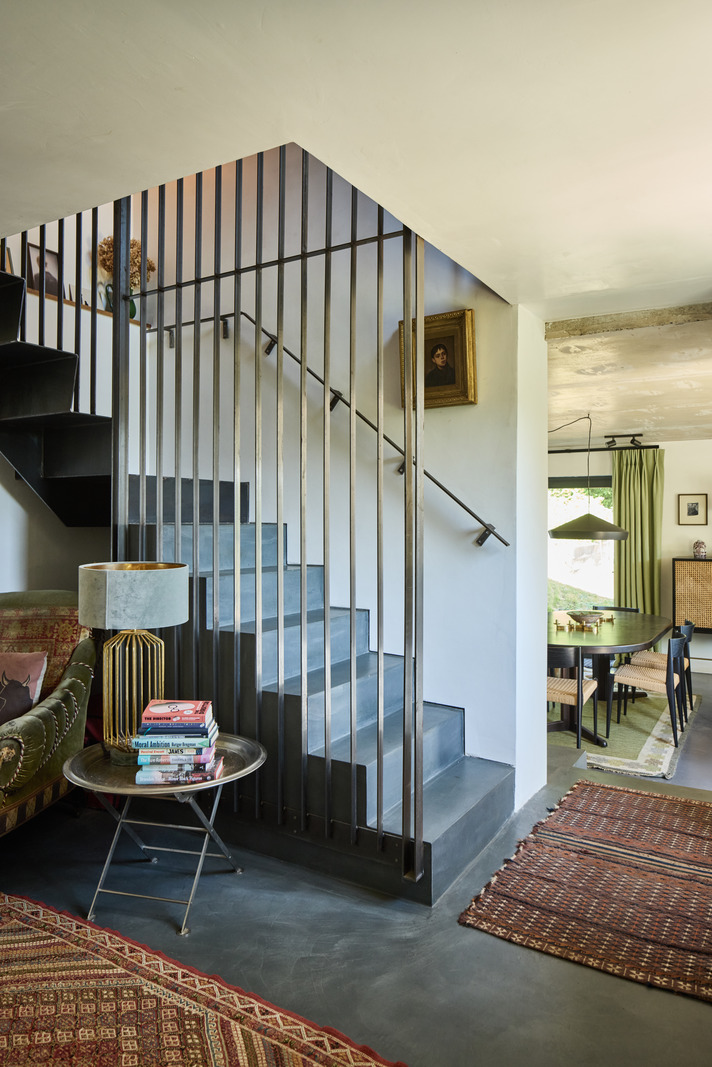
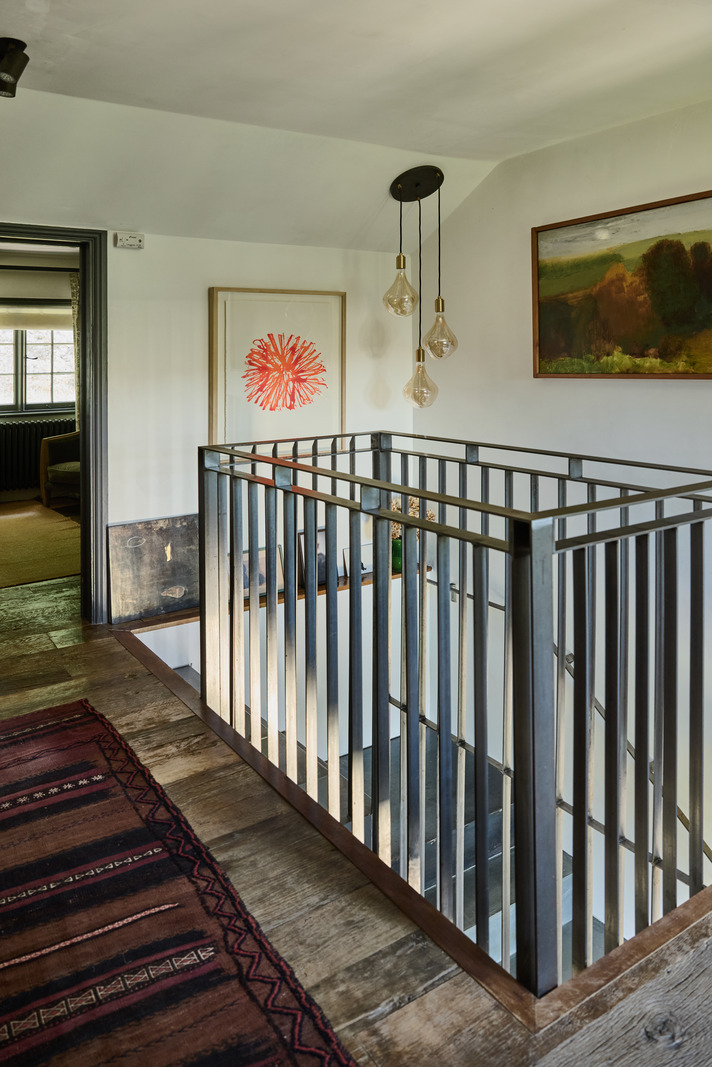
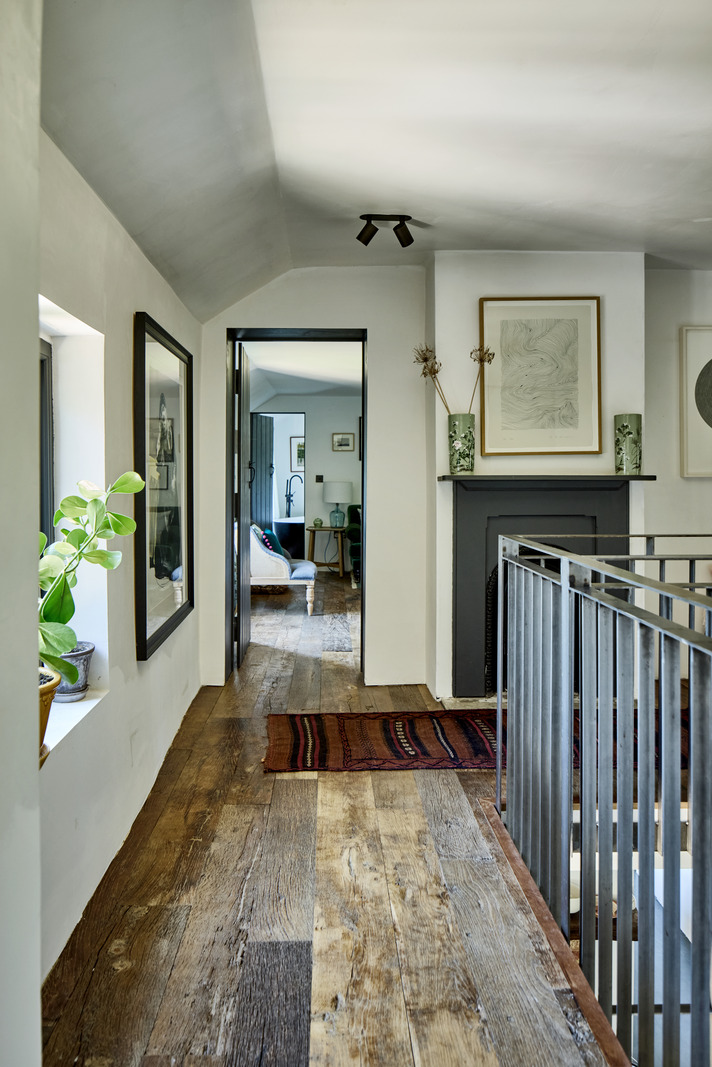
The stairwell, with its black steel posts repeated at regular intervals from floor to ceiling, forms a graphic screen that divides the space while remaining light. You can see through it, light passes through, and perspectives intersect. The steel has a slightly oxidized matte finish that warms the gray hue.
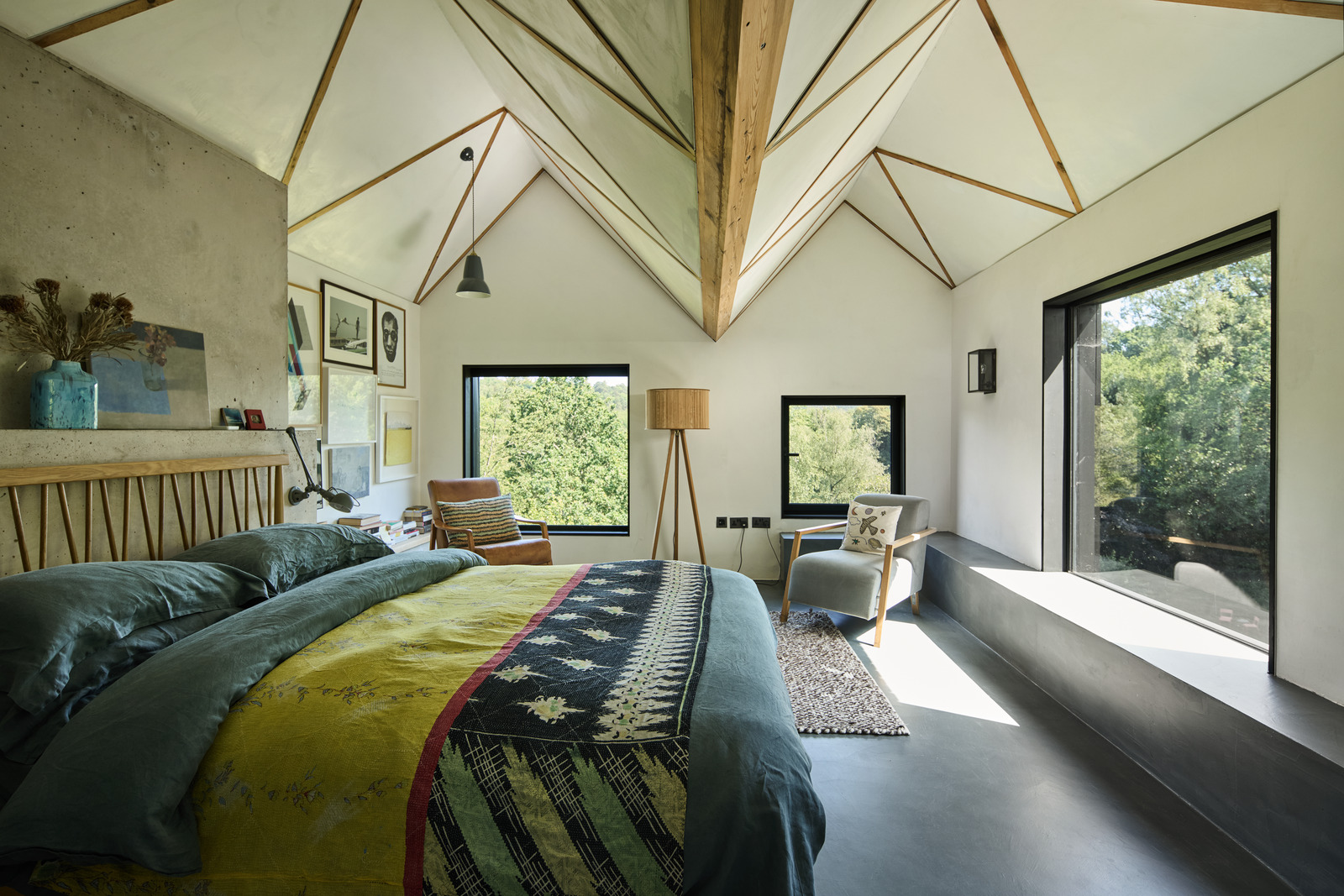
The master bedroom, located in the gabled-roof extension, is spectacular. Solid wood trusses crisscross in a V-shape above the bed, and this exposed structure transforms the ceiling into a sculpture. “Picture windows” frame the tree canopy. A low bed with petrol-blue linen sheets, a Kantha quilt with Indian motifs, and a rattan floor lamp decorate this understated yet warm space.
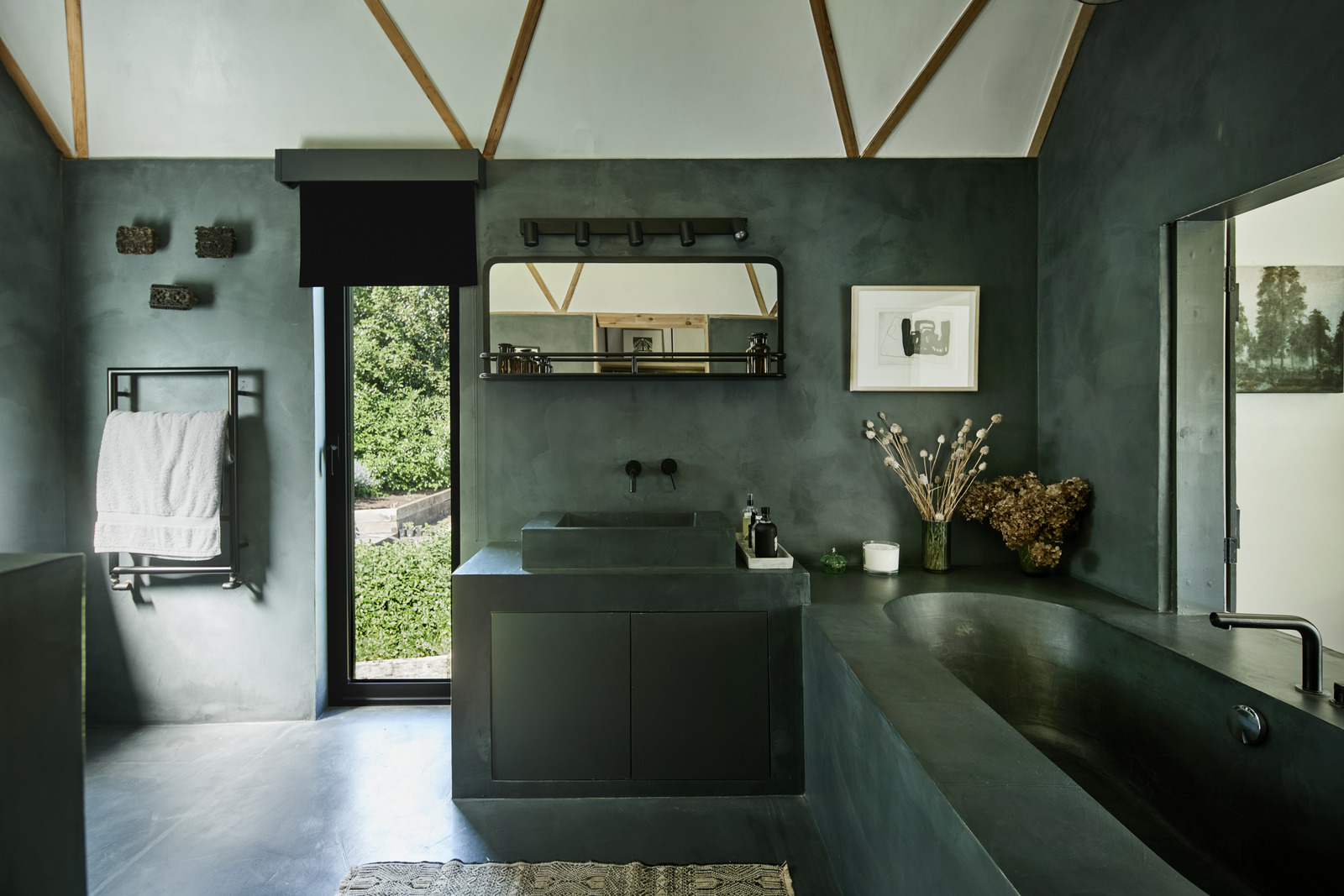
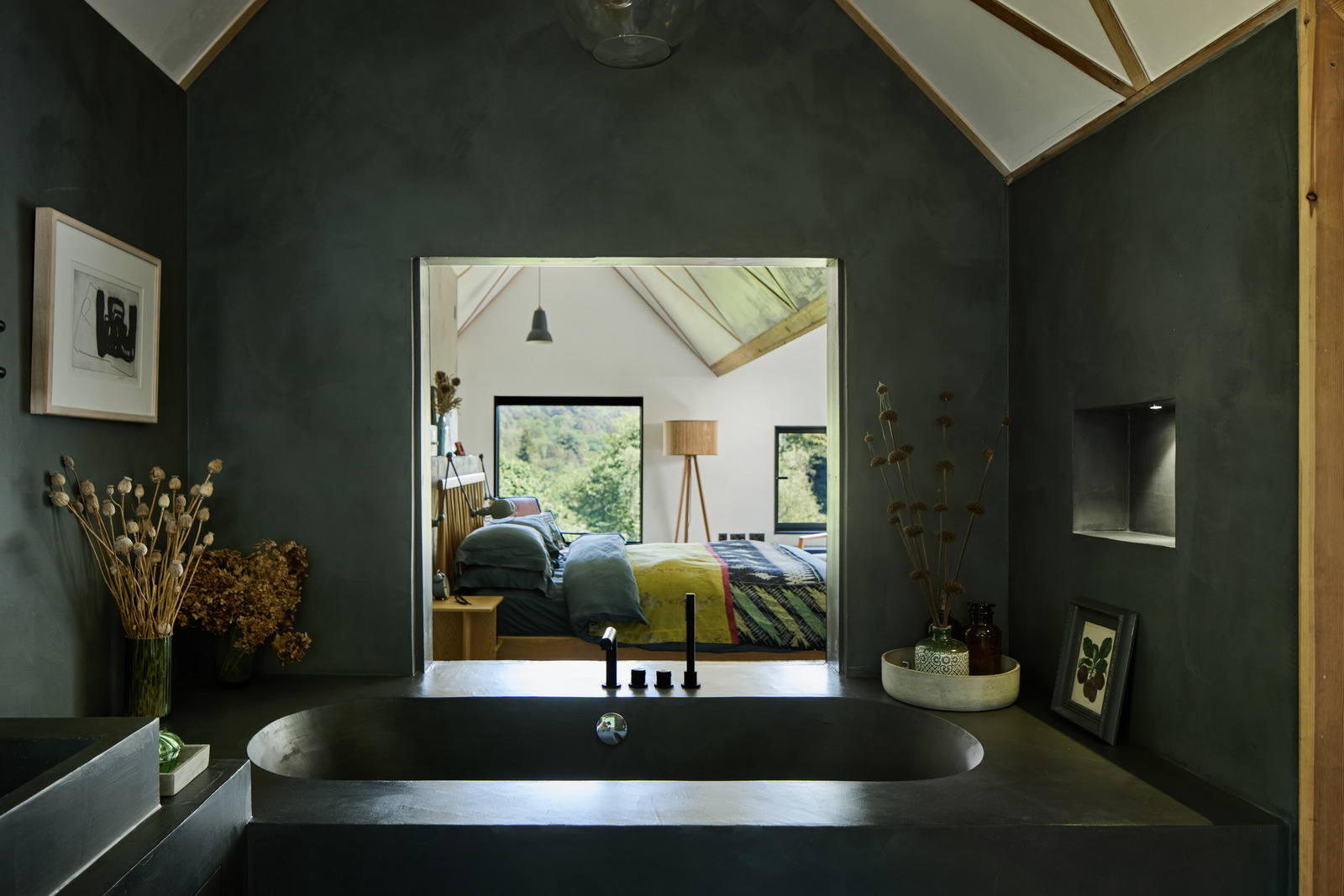
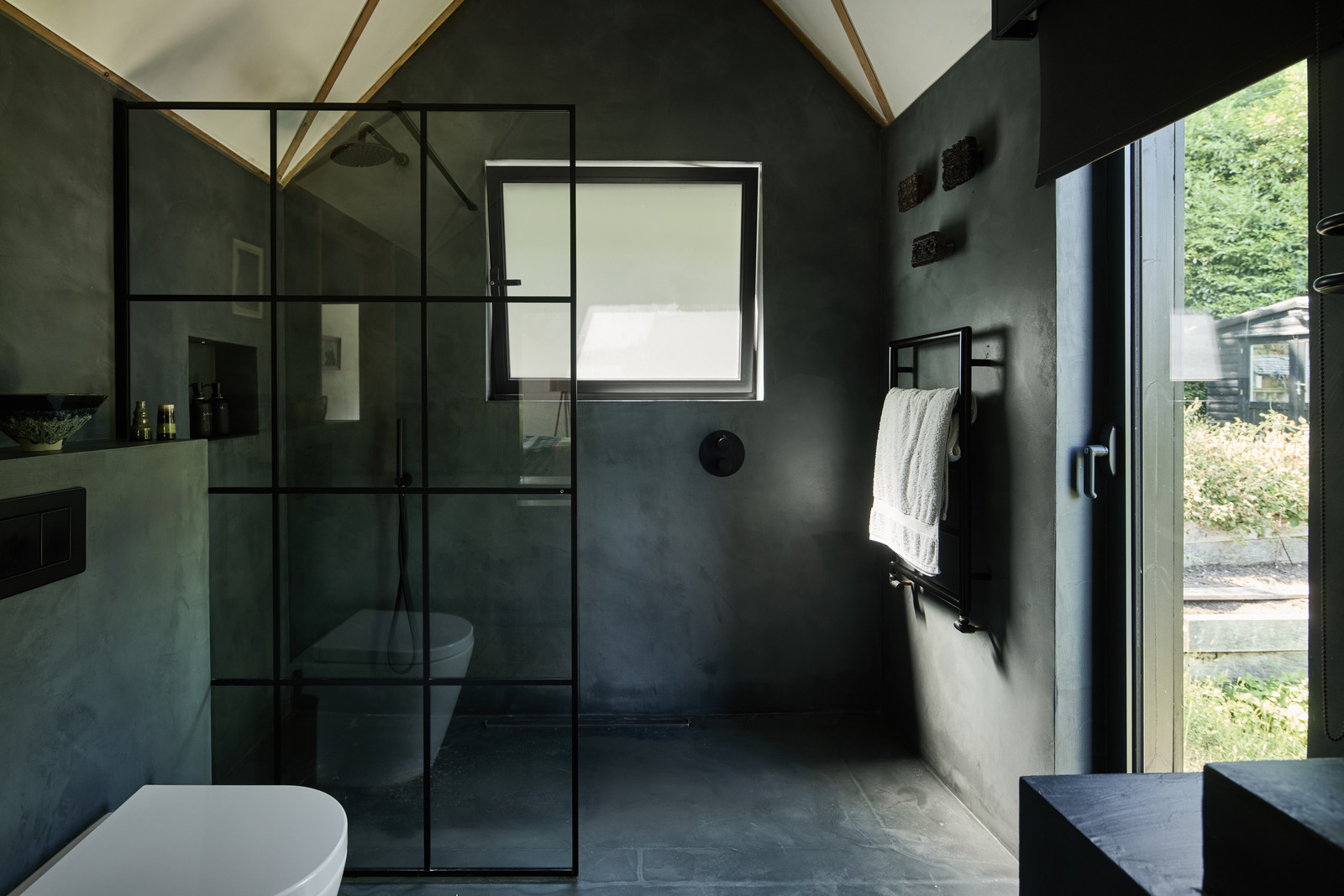
The adjoining bathroom takes the experience a step further. Entirely coated in a khaki-green concrete that’s almost black, it contrasts sharply with the brightness of the bedroom. A built-in bathtub, the one-piece sink, the black steel and glass shower enclosure, and the matte black fixtures are all chosen from the same color palette.
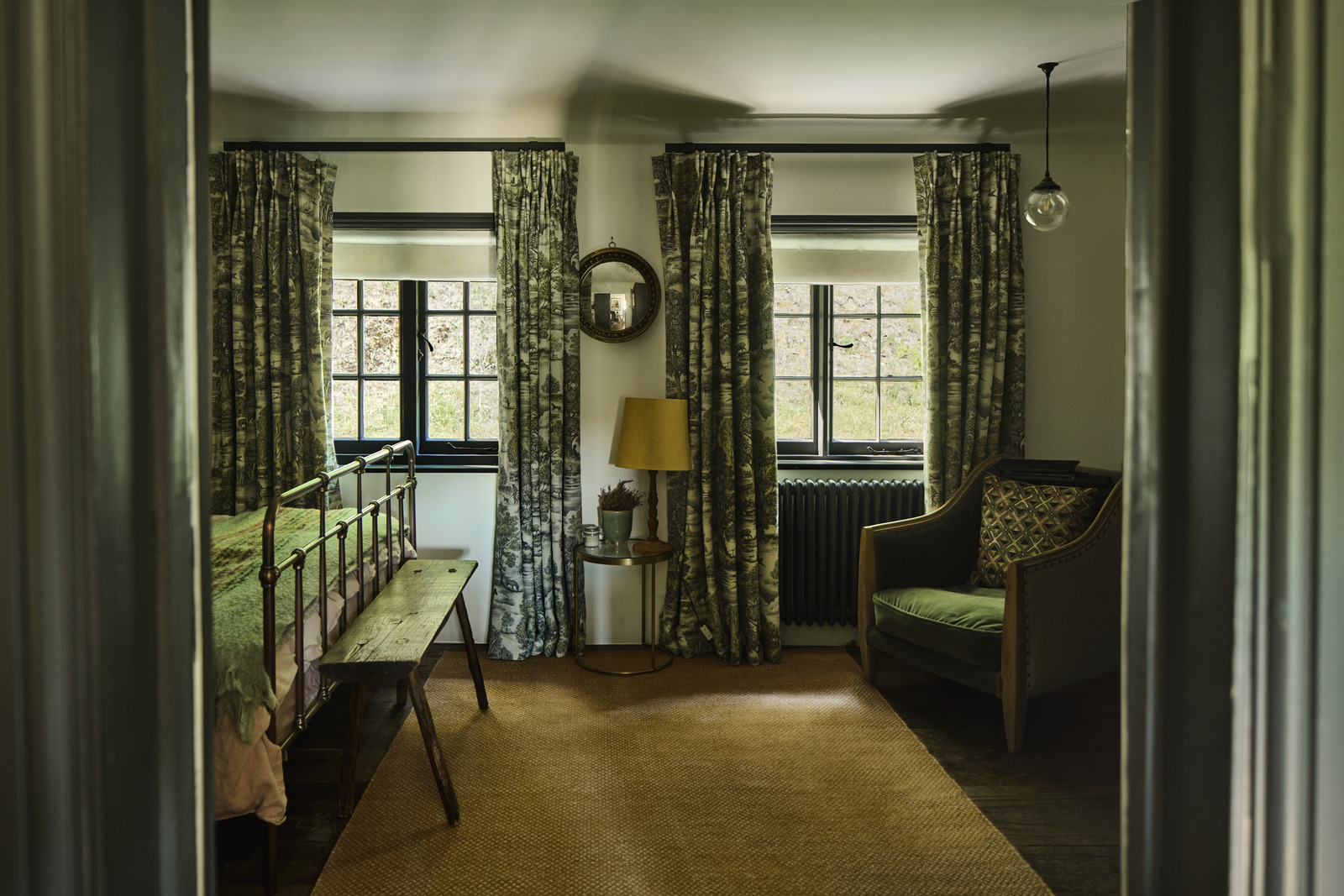
The bedroom in the old wing tells a completely different story. A forest-green Toile de Jouy curtains bring a touch of France into this historic room. Yet its antique metal bed, upholstered armchair, and seagrass rug are thoroughly English. It is the original cottage reclaiming its identity, with a taste for printed fabrics and antique furniture.
The approximately 6,000sqm grounds are an integral part of this former English cottage . Sam Ovens, a renowned landscape architect, worked the slopes of the land to create successive levels. Grasses, perennials, and mature trees form a bucolic backdrop. There is also a pond, dug at the bottom of the garden, complete with a wooden dock.
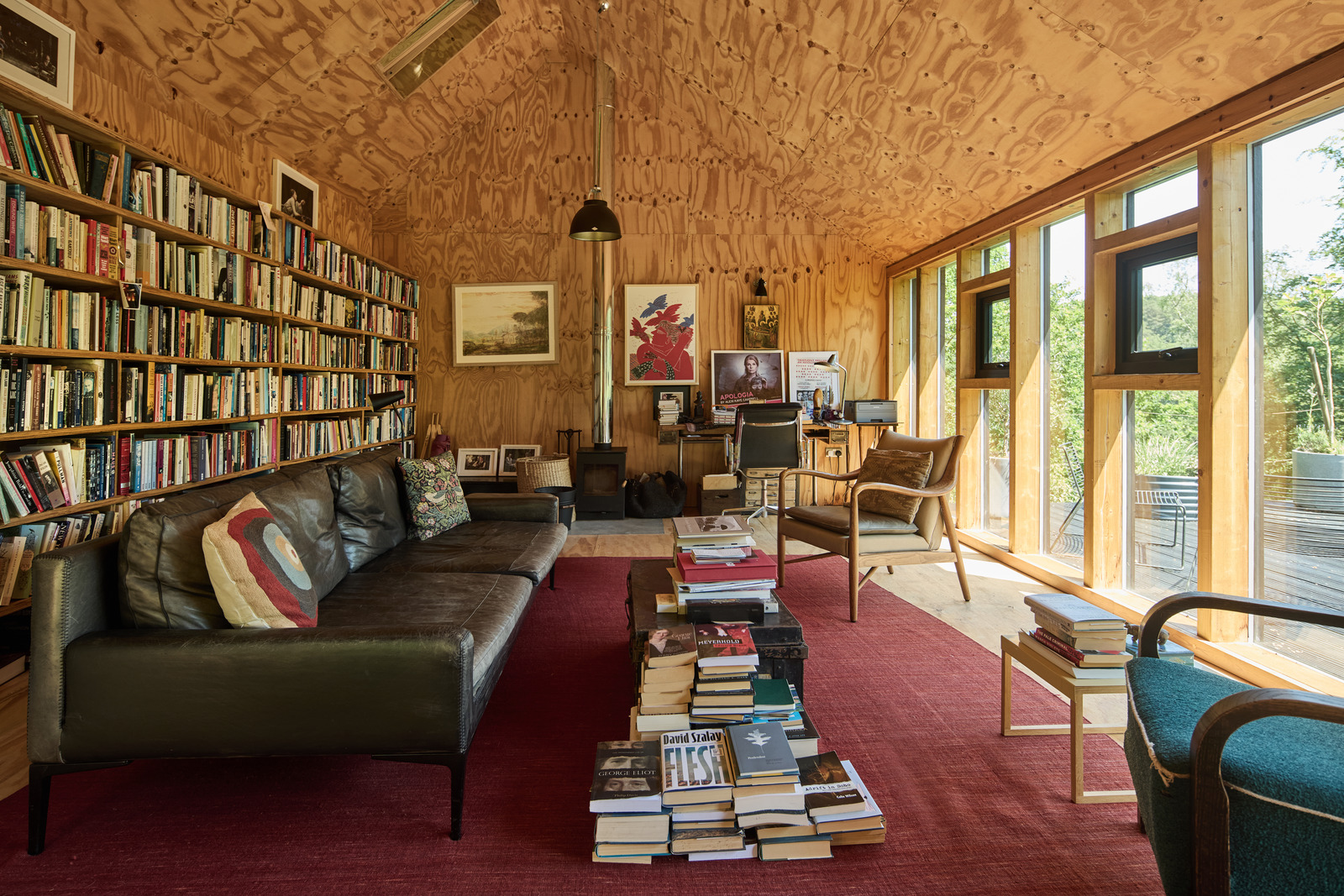
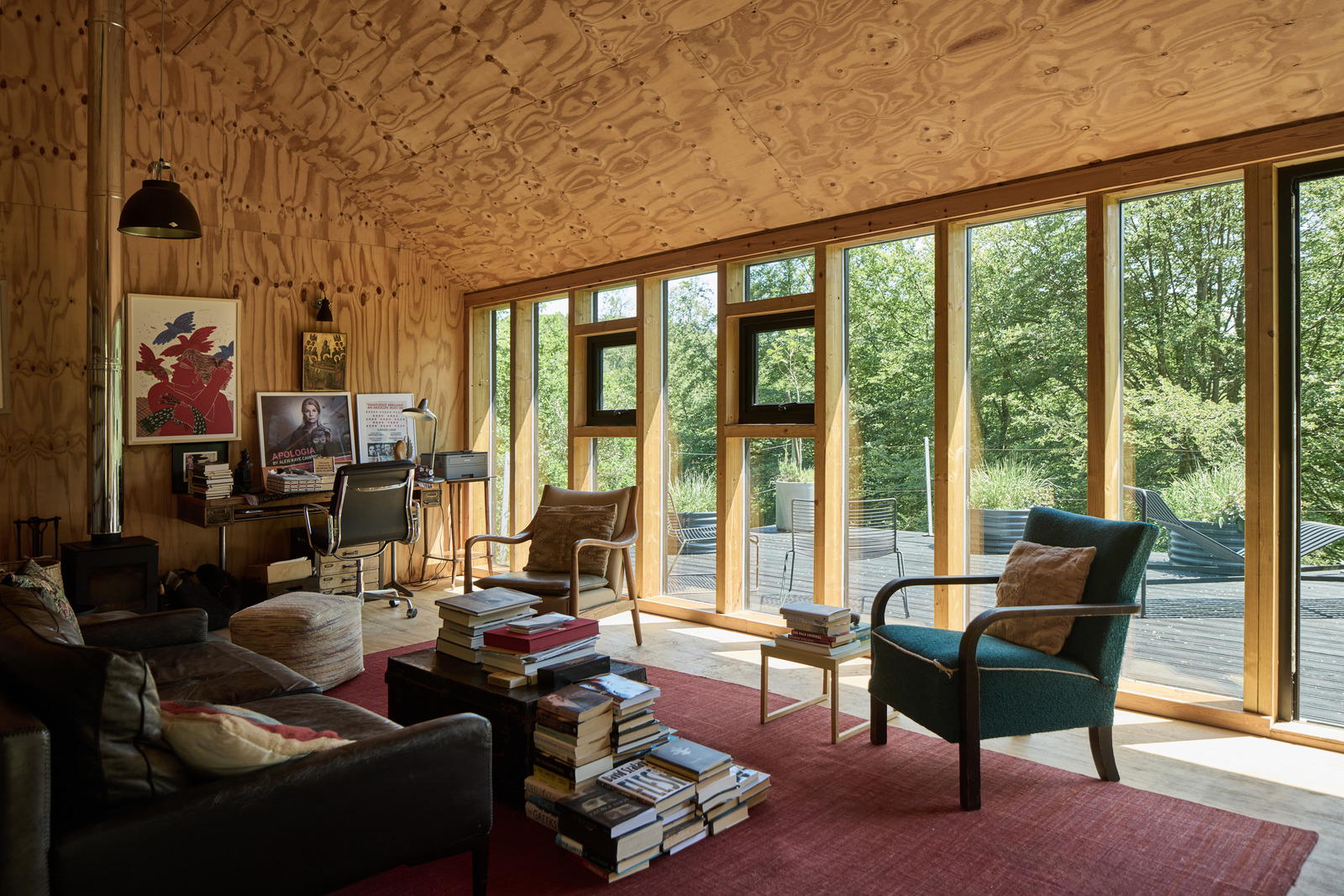
The two studios, also clad in charred wood to echo the main extension, blend into the surrounding vegetation. Their interiors are finished in Douglas fir plywood; each features a wood-burning stove and offers a beautiful view of the trees.
The Hampshire-Surrey area where this 19th-century cottage, Folly Cottage, is located is one of the most beloved in the English countryside. Moors of Hindhead Common and the Devil’s Punch Bowl, owned by the National Trust, are just a few minutes’ walk away. The South Downs walking trails wind through landscapes that have remained virtually unchanged for 200 years. The nearest village, Churt, is home to the authentic and indispensable pub.

This 19th-century English cottage converted into a contemporary home, Folly Cottage, is for sale at The Modern House
A dual architectural identity
The story begins in 1802 with a solid, modest stone worker’s cottage, built with no ambition other than to shelter simple lives. Two centuries later, the London-based firm Invisible Studio, winner of the RIBA Prize, received a unique commission. It was tasked with transforming the property into a 21st-century home without betraying its working-class heritage.
The charred wood extension, a bold gamble
The result is immediately apparent as soon as you arrive on the garden side. A contemporary extension, clad in charred wood using the Sho Sugi Ban technique, rises perpendicular to the original cottage. The contrast between the ochre stone and red bricks on one side, and the matte black volume on the other, is stark. Yet, far from being jarring, it is original and innovative. The extension’s gabled roof mirrors the original’s profile, and this continuity of silhouette is enough to reconcile the two eras. From the garden, the eye moves seamlessly from one to the other.
This type of intervention is characteristic of Invisible Studio’s approach. The studio often works with raw materials, wood, earth, hemp, stone, and here, concrete takes center stage.
The kitchen and living spaces, concrete and eclecticism
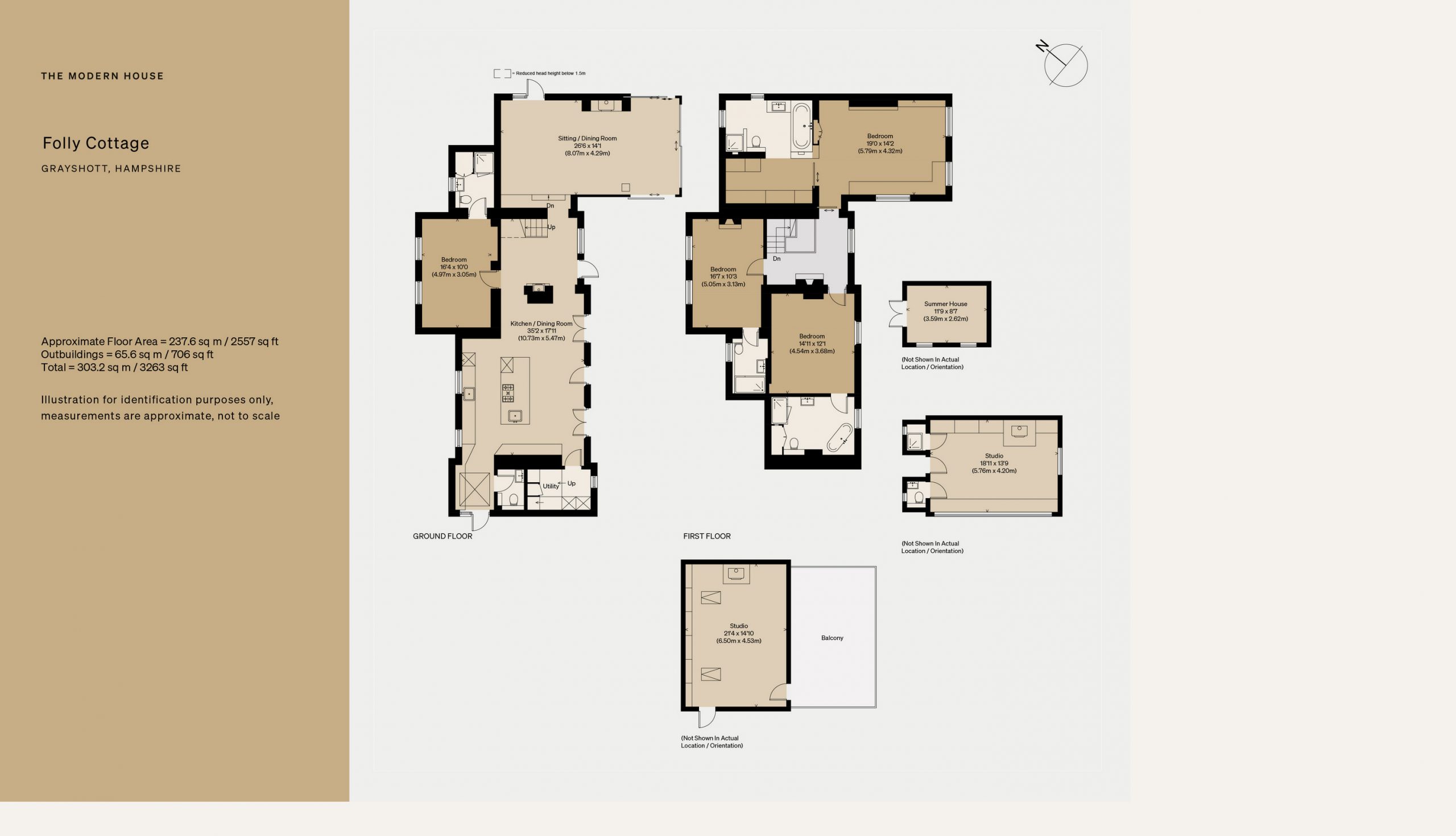
You enter through a functional porch. The kitchen is immediately on your left, and there, the tone shifts. The light-wood-colored cabinets are complemented by poured-in-place concrete countertops with a slightly irregular texture.
An antique table, Eames chairs
Two matte gold brass pendant lights hang above the dining table, an antique table made of raw wood surrounded by poppy-red Eames chairs. This contrast, a weathered farmhouse table paired with iconic designer chairs, is a decorative concept we often see, and it works well despite the seemingly opposing styles.
The glass-enclosed living room, the contemporary heart of the home
Its polished concrete floor continues throughout the living space. The living room, set slightly lower, is furnished with a Togo sofa in blue-gray velvet, one of the classics of French design by Michel Ducaroy for Ligne Roset. The kilim rug in shades of green and gray adds an ethnic touch. Two wood-burning stoves,one built into a sculpted concrete wall, the other placed in a corner, warm this large, bright room.
The large sliding glass doors that open the living room onto the garden offer a view of the trees and the magnificent garden designed by landscape architect Sam Ovens. They allow the vegetation to visually flow into the house. This room is like a luminous box that blurs the boundaries between inside and outside.
The staircase, a sculptural object
The stairwell, with its black steel posts repeated at regular intervals from floor to ceiling, forms a graphic screen that divides the space while remaining light. You can see through it, light passes through, and perspectives intersect. The steel has a slightly oxidized matte finish that warms the gray hue.
Very different bedrooms
The master bedroom and its V-shaped trusses
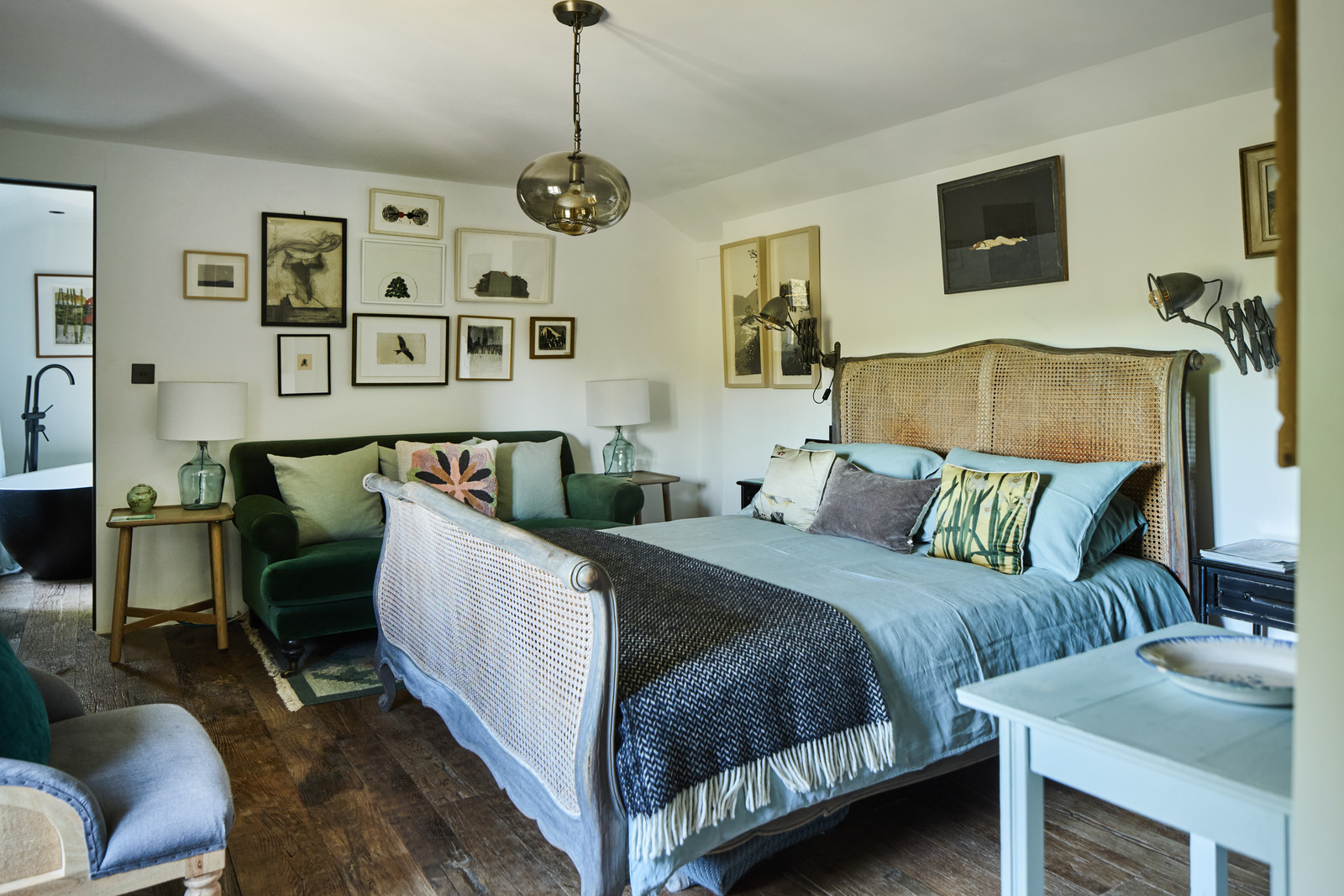
The master bedroom, located in the gabled-roof extension, is spectacular. Solid wood trusses crisscross in a V-shape above the bed, and this exposed structure transforms the ceiling into a sculpture. “Picture windows” frame the tree canopy. A low bed with petrol-blue linen sheets, a Kantha quilt with Indian motifs, and a rattan floor lamp decorate this understated yet warm space.
The bathroom, black and radical
The adjoining bathroom takes the experience a step further. Entirely coated in a khaki-green concrete that’s almost black, it contrasts sharply with the brightness of the bedroom. A built-in bathtub, the one-piece sink, the black steel and glass shower enclosure, and the matte black fixtures are all chosen from the same color palette.
The old wing in such an English style (with a touch of French)
The bedroom in the old wing tells a completely different story. A forest-green Toile de Jouy curtains bring a touch of France into this historic room. Yet its antique metal bed, upholstered armchair, and seagrass rug are thoroughly English. It is the original cottage reclaiming its identity, with a taste for printed fabrics and antique furniture.
A 6,000sqm park and two treehouse studios
Sam Ovens’ garden
The approximately 6,000sqm grounds are an integral part of this former English cottage . Sam Ovens, a renowned landscape architect, worked the slopes of the land to create successive levels. Grasses, perennials, and mature trees form a bucolic backdrop. There is also a pond, dug at the bottom of the garden, complete with a wooden dock.
The studios, retreats at the far end of the park
The two studios, also clad in charred wood to echo the main extension, blend into the surrounding vegetation. Their interiors are finished in Douglas fir plywood; each features a wood-burning stove and offers a beautiful view of the trees.
The Hampshire and Surrey region
The Hampshire-Surrey area where this 19th-century cottage, Folly Cottage, is located is one of the most beloved in the English countryside. Moors of Hindhead Common and the Devil’s Punch Bowl, owned by the National Trust, are just a few minutes’ walk away. The South Downs walking trails wind through landscapes that have remained virtually unchanged for 200 years. The nearest village, Churt, is home to the authentic and indispensable pub.


This 19th-century English cottage converted into a contemporary home, Folly Cottage, is for sale at The Modern House


Comments